
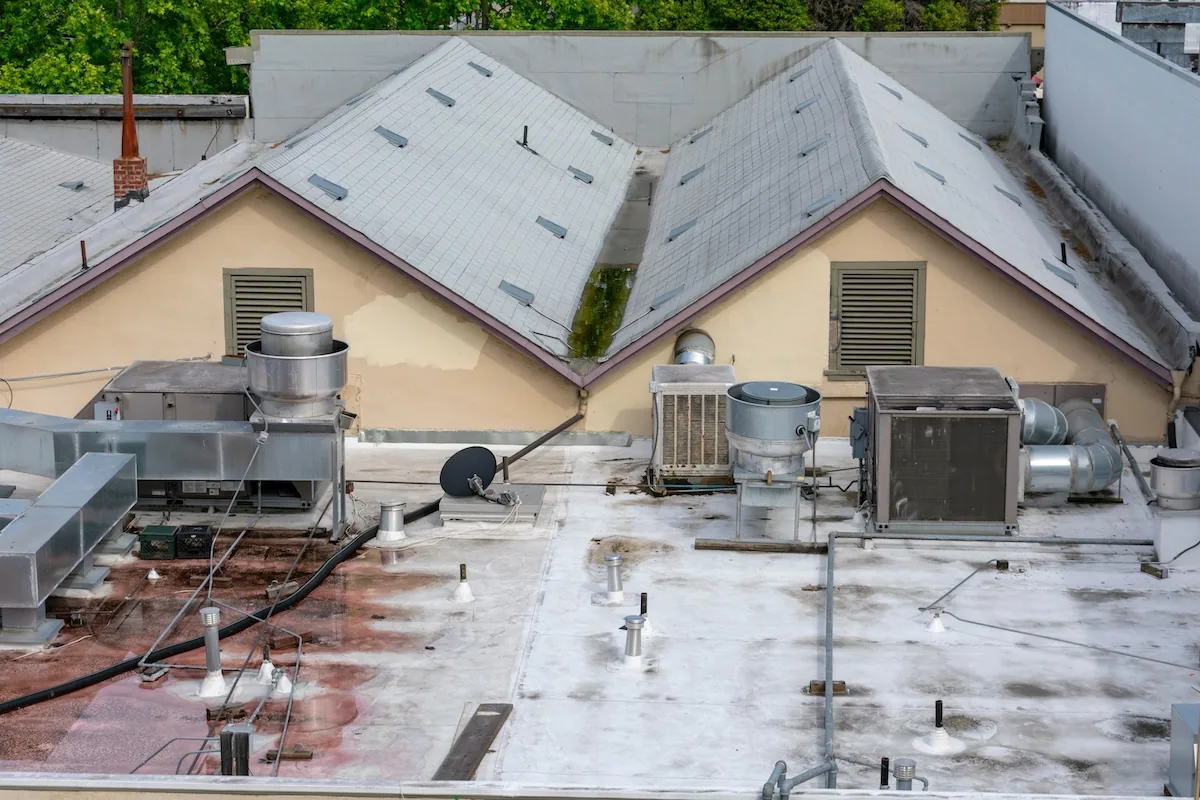
Commercial Roof Leak Repair in Dearborn, MI
A leak above a production floor can damage equipment or interrupt work before the roof defect is visible from inside. We respond by protecting the affected area, identifying where water is entering, and tracing the route through the roof assembly. A ceiling stain gives us a starting point, not a repair location. The crew checks seams, penetrations, curbs, parapets, and drains, then compares those details with the interior signs.
Dearborn's climate brings precipitation through much of the year and snowfall across the colder months. We plan a safe access window and control water while investigating the source. If the roof is actively open or interior conditions need immediate protection, emergency roof response can stabilize the area. Once the building is protected, we define the permanent repair and record what remains for follow-up.
Trace the Water Path
Water can move across a deck or within insulation before it reaches a ceiling. We start at the affected interior area, inspect above it, and widen the search along roof slope, seams, penetrations, and transitions. A drain blockage, failed curb flashing, open lap, or puncture can send water toward a distant low point. We check likely entry details rather than sealing only the spot over the stain. Photos and marked locations help the facility director understand the evidence and the repair boundary.
Moisture may be limited to one area or extend under a larger section. We use surface review and testing to tell the difference, then identify whether insulation needs to be opened and replaced. An infrared moisture survey can help locate suspect zones, while a core cut can confirm material layers and wetness at a specific point. We explain how each finding affects the repair before covering the area again.
Check the Details That Admit Water
At a seam, we look for separation, contamination, failed welds, or an edge that no longer holds. At a penetration, the concern may be cracked flashing or movement where the pipe or equipment meets the membrane. At a parapet, the transition can split where the wall and roof move differently. We inspect nearby material for cracks and weak adhesion because a repair patch needs sound membrane to bond. The repair method follows the system already on the building.
The Dearborn station normals show 35.05 inches of mean annual precipitation and frequent measurable precipitation during most months. For leak diagnosis, drainage therefore stays in the inspection sequence. We check drain bowls, scuppers, strainers, and low spots for blockage or standing water that may stress seams and flashing. A seam repair will not solve a blocked outlet, so we document both the entry point and the conditions that keep water there.
Stop the Leak Without Hiding the Cause
When the defect is isolated and the surrounding assembly is sound, we remove failed material, prepare the surface, and restore the system detail with compatible components. If wet insulation extends beyond the opening, that material may need to come out before the membrane closes the roof. If multiple seams or details have failed, we compare individual repairs with a broader scope. We state what is fixed, what was opened, and what remains under observation. A patch is not described as a full system restoration.
A leak over an occupied storefront can reach customers, deliveries, or interior finishes, and the retail and food-service uses along Dearborn's downtown and Dix-Vernor corridors leave little room to close a space, so the repair window and protection are set with the property contact. For membrane damage, planned commercial roof repair can address the detail after the active water is controlled. The EPDM system or another compatible assembly determines the repair materials and sequence.
Protect the Interior While Work Proceeds
We agree on the affected room, equipment, inventory, and access route before the roof is opened. Where practical, we place interior protection below the work zone and coordinate with the person responsible for the area. If water is still entering, we contain it, remove standing water where possible, and secure a temporary cover until the permanent repair can be installed. The temporary measure is identified as such in the work record, with a follow-up plan tied to safe conditions and material requirements.
Dearborn's commercial activity includes professional, healthcare, and education uses, along with manufacturing. Each building's operating needs vary, so the access window and interior safeguards come from the facility contact. We keep crews, tools, and materials within the agreed work area and check the tie-in at the end of the shift. If the affected area is near a sensitive process or public route, staging and communication can be adjusted before permanent repair begins.
Use Local Context to Set the Inspection
In a city with both commercial corridors and major employment uses, roof access and interior consequences can differ from one building to the next. Dearborn identifies Ford Motor Company as a major employer with a research-and-development complex, and its commercial districts include food, retail, and professional services. Before setting the work sequence, we ask about operating hours, rooftop equipment, and the rooms below the leak, because the answers change where protection goes and when the crew can open the roof.
The Warren Avenue corridor runs from Greenfield Road to Wyoming Avenue and includes pharmacies and medical offices as well as food and retail businesses. For a facility in that district, we coordinate roof access with the property contact and make the interior work boundary clear. A Warren Avenue roof visit begins with the actual entry details, not a standard repair assumption. We can also arrange a broader roof inspection when the leak appears to be one of several defects.
Leave a Record for the Next Wet Period
After the repair, we provide photos, the location of the defect, the system detail addressed, and any area that still needs monitoring. The record helps the next visit start with known conditions rather than repeating the first search. A written condition report can also support planning when the roof has several repairs or multiple property teams need the same information. We distinguish completed work from recommendations so the owner can assign and schedule the next step.
Dearborn normals place the first measurable snowfall around mid-November and the last around early April. Before the next season, a roof maintenance visit can clear outlets, inspect repaired details, and check for new water entry. If another leak appears, the prior record makes it easier to compare locations and determine whether the original boundary changed. The next visit can then compare any new leak against the recorded repair.
Commercial Roofing Questions
Why is the leak showing in a different place from the roof opening?
Water can travel beneath the membrane before reaching the deck or ceiling. We compare interior evidence with the roof slope, seams, drains, and penetrations, then follow the likely water path. The opening is repaired after the entry detail and surrounding material are checked.
Do you need to open the roof to trace a leak?
We begin with a visual roof and interior review. If moisture may extend below the surface, a test opening or core cut can confirm the assembly at a specific point. We explain the reason and location before opening material, then document what the test shows.
Can you stop the water before the permanent repair?
We can protect the interior and install a temporary cover or other appropriate dry-in measure when conditions permit. The temporary work is recorded separately from the permanent repair. We then schedule the final detail when access and material requirements allow it.
Will you repair the roof if the insulation is wet?
We first map how far the moisture extends. A small wet area may be removed and replaced within a larger sound assembly. Widespread wet insulation can require a broader scope, because placing a patch over it leaves the underlying material in place.
What information do I receive after leak repair?
You receive the repair location, photographs, a description of the detail addressed, and any follow-up condition. We note whether the work resolved an isolated defect or whether drainage, moisture, or adjacent seams need further review.
Trace the Leak and Set the Repair
Schedule a roof inspection or request emergency response for active water entry. We will document the source, repair boundary, and follow-up decision.