
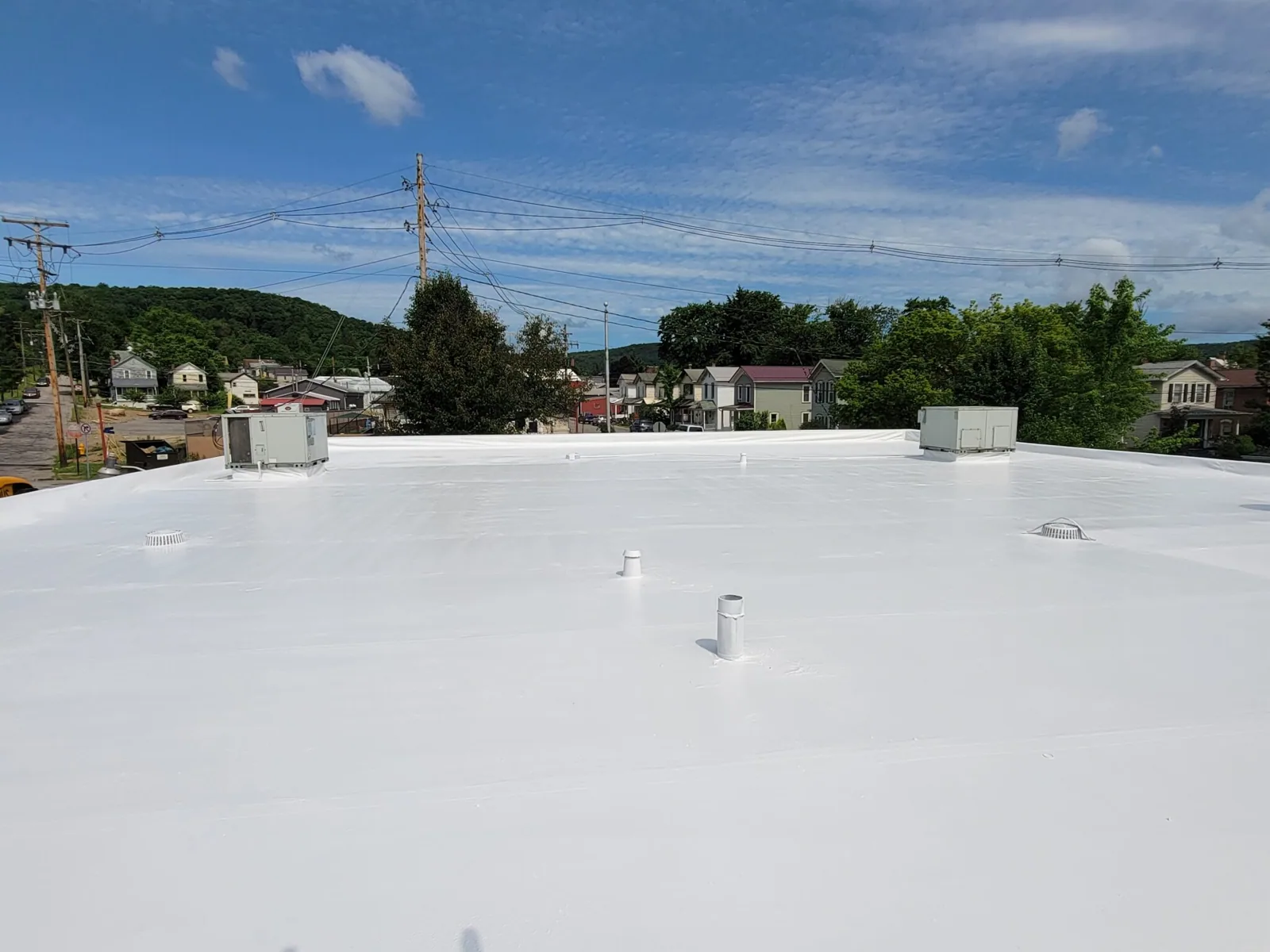
Seam Failure Repair in Dearborn, MI
A manufacturing plant with a single-ply roof and a retail strip with a modified bitumen roof both depend on their seams, and both lose seams for different reasons. On the plant, long runs of welded laps sit in the open under sun and snow. On the strip, side laps and end laps have been walked on by service crews for years. Seam failure repair in Dearborn, MI starts with a probe, because a lap that looks closed from above may not be bonded beneath, and a lap that looks open may be nothing worse than a curled edge.
We walk each lap in sequence, one roof section at a time, mark where the probe slides in, and photograph each mark with its distance from a fixed point, so a crew returning next season can find the same lap without a guide. That inventory is what the repair is priced from.
Seam Types and the Detail That Controls
Seam construction depends on the system. Thermoplastic sheets such as TPO and PVC are joined by hot-air welds, and a weld made on a dirty or cold surface can separate later. Rubber sheets are joined by tape or adhesive, and a splice can release if the surface was contaminated or the joint was overstressed. Modified bitumen laps are torch-applied or cold-bonded and open at side laps and end laps. Metal roofs have panel seams, clips, and sealant. Built-up roofs have ply edges and flashing tie-ins instead of laps.
Identification comes first. A patch that bonds to one sheet will not bond to another, and a weld temperature that suits one will damage another. We confirm the membrane by sample, label, or record before touching a seam, and we note the attachment method, since a mechanically attached roof loads its laps differently from an adhered one.
Failure Mechanisms
Seams fail for reasons the roof will show. Movement concentrates stress at laps near expansion joints, at deck changes, and along perimeters. Standing water sits on a lap and ages it. Foot traffic grinds an unprotected lap. A poor installation leaves a cold weld or a skipped length of adhesive. Sun and age stiffen a sheet until its edge cracks.
Cold plays a large part in Dearborn. A typical Dearborn year brings about 4,027 heating degree days and 30.8 inches of snow, with the snow season running from roughly the middle of November into early April. Water that enters an open lap freezes, expands, and widens the gap, then thaws and enters again. Because of that cycle, an open seam found in January may need a temporary seal until spring weather allows the permanent repair, since many welds and adhesives need a minimum temperature. Chronic ponding over a seam is corrected before the seam is repaired.
Repair Methods by System
On TPO and PVC, an open lap is cleaned and rewelded, or a strip of matching sheet is welded over it. A test weld is made first each day. On EPDM, the splice is cleaned, primed, and re-bonded with the maker's tape or adhesive system, with a cover strip where the old splice is damaged. On modified bitumen, the lap is warmed and pressed, or re-adhered with cold adhesive, and the edge is sealed.
After the work, each new seam is probed along its length, and where the system allows, a peel test on a sample strip confirms the bond. A photograph with a scale marks the repair. The record notes the temperature and weather at the time, since they affect the bond and explain a later failure if one occurs.
Repair Boundary and Remaining Service Life
A few open laps are a repair. A roof whose laps are open across a large share of its area is a different problem. The repair boundary is the point at which continued patching costs more than a recover or replacement for the remaining service life, and the written findings state it with the observations behind it: how many laps are open, how widely they are spread, whether the sheet at the lap is still flexible, and whether the insulation beneath is dry.
When the membrane has aged until it will not weld or bond, patches are temporary, and that goes in the file. A commercial roof repair then becomes a short-term measure with a follow-up date while the owner plans replacement or a coating restoration of any section that is still sound.
Plants, Campuses, and Corridor Buildings
The city calls itself an employment center for metropolitan Detroit, where manufacturing, schools and health care, and professional services supply most jobs, and it names Ford as the largest employer, with a research complex being rebuilt. Roofs on plants and technical buildings often have long seam runs and many penetrations, which multiplies the places a lap can fail. Campus roofs at the University of Michigan-Dearborn and Henry Ford College mix building ages and shapes, and a college or university roof is surveyed section by section.
Each survey starts from what the walk finds, and long runs are broken into numbered sections with measured lengths. The same method serves the retail roofs of the Warren Avenue corridor and the mixed-use redevelopment the city describes around Fairlane and Ford Road, where lap condition varies from one roof to the next.
Reading Earlier Repairs
A lap that has been patched before tells a story the file should keep. Curling patch edges, layers of sealant over a lap, and mismatched colors show that the same spot has failed before. We map earlier repairs on the plan and count how many fall on laps and how many on flashings. If most sit on laps, the sheet is probably losing its ability to bond, and another patch is likely temporary. A neighboring flashing failure is checked in the same walk.
Records from earlier contractors help when they exist. Where they do not, this visit's photographs begin the history, and the owner has something to give a lender, an insurer, or the next property manager.
Commercial Roofing Questions
How do you find a seam that has not leaked yet?
With a probe along each lap, plus a moisture scan on larger roofs. The probe finds unbonded sections before water does, and each one is marked with a distance from a fixed point.
Can a seam be repaired in cold weather?
Some methods work in the cold and some do not. A temporary seal may go on in winter, and the permanent repair waits for conditions the materials need, which the written findings state.
What is a cover strip?
A strip of matching sheet or tape bonded over a damaged seam on both sides. It protects the lap when the original seam cannot be welded or bonded again.
How is the new bond tested?
The seam is probed along its length, and where the system allows, a peel test on a sample strip shows whether the bond is real. Results go into the file.
When does seam failure point toward replacement?
When open laps cover too much of the roof, when the sheet is too aged to bond, or when the insulation beneath is wet. The file shows the point past which patching stops paying and the observations behind it. A roof plan with the probe results marked on it gives the next crew the exact starting point.
Where do seams fail most often?
Near expansion joints, deck changes, perimeters, and under standing water. We number and photograph each so patterns appear over time.
Send the leak history and the membrane type
Send the building address, the membrane type if known, past seam repairs, and the access window. We will return written findings with a numbered seam inventory, the method for each open lap, and the repair boundary.
