
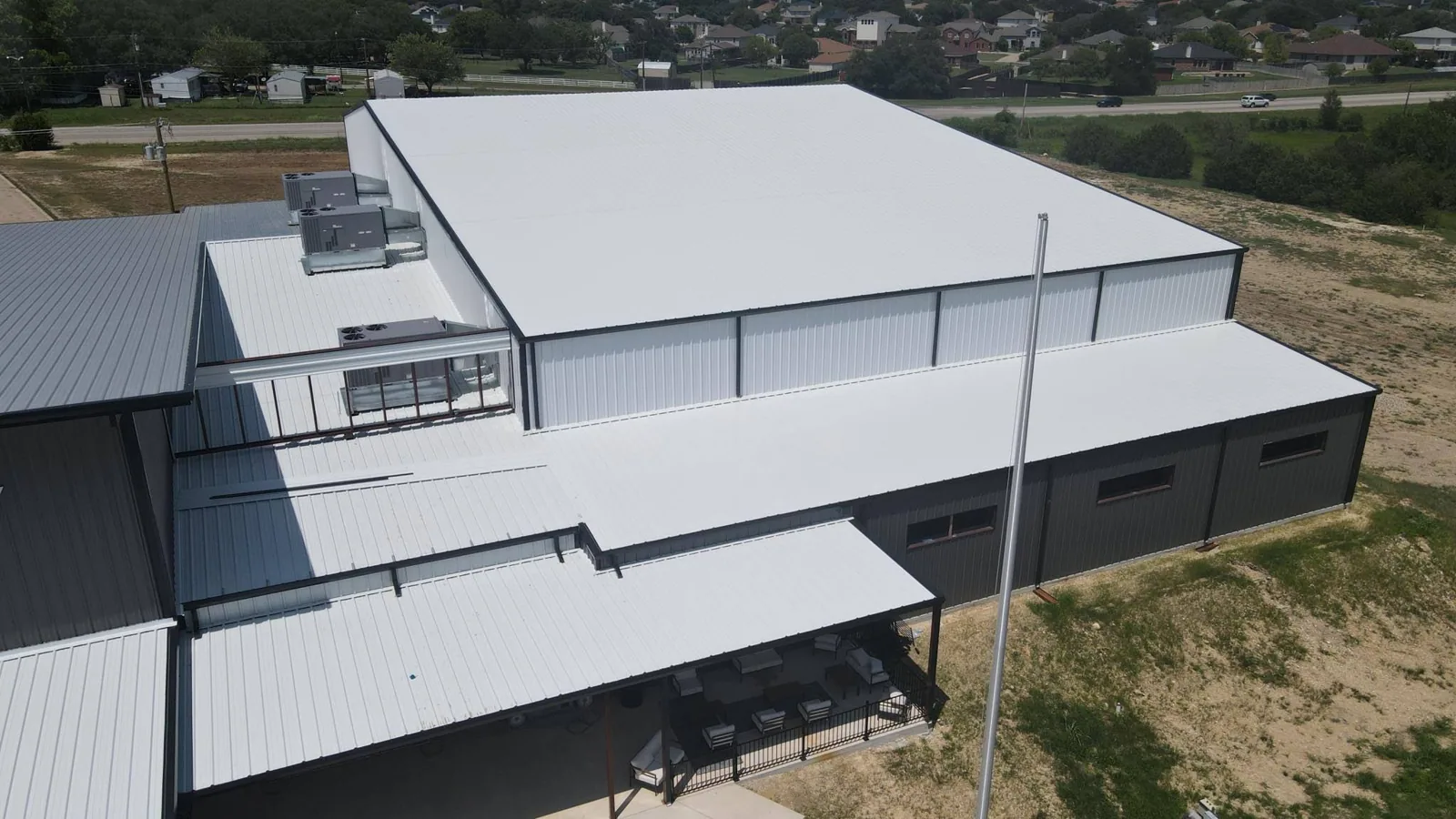
Army Installation Roofing Near Dearborn, MI
Engineering offices, maintenance shops and operations buildings on an Army installation carry the same low-slope roof assemblies as a corporate campus, yet the decisions around them are different. The Army reports that Detroit Arsenal in Warren contains 74 buildings across 181 acres, and its published phonebook separates emergency operations, engineering, maintenance and master-planning functions into designated buildings. A roof over an operations office has to stay dry for a reason that a roof over a storage bay does not share, so the first step is to name what the roof protects.
The arsenal sits about 15 miles northwest of Dearborn, MI, and its roofs sit through a winter in which the Dearborn weather station logs most of its yearly 30.8 inches of snow between November and April. We start with the access, criteria and calendar steps of military installation roofing, then fit them to the building, whether it resembles a government office roof or a shop with heavy equipment.
Support Buildings and the Rooftops Above Them
The installation phonebook describes a multi-use administrative and support building stock, with engineering, maintenance, master-planning and operations each housed under its own heading. That mix matters on the roof. An office building usually carries rooftop air handlers and a modest number of drains. A maintenance building is more likely to have exhaust fans, make-up air units and heavier traffic from service staff walking the roof to reach them.
Each of those uses changes where the membrane wears first. Around frequently serviced equipment we look for scuffed membrane, loose walkway pads and curb flashing that has been stepped on. Around quiet office roofs the wear shows up at drain bowls and parapet corners. A written inventory of every curb, vent and drain gives a planner a defensible list, and the roof condition report is where that inventory lives.
Gate, Escort and Work Area Planning
Roof work on an installation starts at the gate. Visitors and contractors are usually badged, vehicles may be inspected, and escorts can be required for areas where the mission is active. These steps change the schedule: a crew that loses an hour at access each morning loses an hour of dry weather, and in a Michigan spring that hour can decide whether a tear-off is closed in by evening.
For that reason we ask for the access procedure, the escort ratio and the staging area before pricing, not after. Delivery windows, hoist locations and the path from staging to the building all belong in the plan. Federal roofing work typically answers to the Unified Facilities Criteria, which is where submittal rules and allowable substitutions are set. We plan the work area around tenants and operations, much as we do for any occupied building reroofing job, with added attention to who may enter the area beneath the roof.
Freeze-Thaw, Ice and Drain Capacity
Heavy snow arrives in January and February, at roughly 14 and 12.5 inches, and the season usually opens in mid-November and trails off in early April. With 4,027 heating degree days a year, the roof assembly works through a long heating season too. Across those months a low-slope roof sees snow pile against parapets and equipment curbs, then partial melt on warm afternoons, then refreezing at night. Meltwater that cannot reach a drain freezes in the field and at laps.
That cycle exposes any seam that was marginal and any flashing that has lost adhesion. On an administrative building with interior finishes below, a small opening can wet ceiling tile for weeks before anyone connects it to the roof. We check drain bowls, scupper throats and the low points between them first, since a blocked outlet turns a manageable melt into standing ice. After heavy storms, snow and ice roof damage shows first at those drains and laps.
Setting the Repair Boundary
A repair on a government building has to be described precisely, because the person who accepts the work may not be the person who sees the roof. We mark the repair boundary on a roof diagram: the seam, curb or drain detail being corrected, the sound membrane around it, and any area where moisture readings suggest wet insulation. Photographs tie each mark to a location for next season comparison.
Hangar roofs follow the same repair logic, with access for an aircraft hangar adjusted for its deck. A seam repair on a sound field sheet is a different decision from a patch over insulation that has taken on water. When the infrared and core evidence points to a wider wet area, a patch only delays the next call. In that case the written findings lay out a section replacement, and we explain how the new work ties into the existing roof. On a reinforced single-ply roof the tie-in is usually a heat-welded or adhered termination, and a TPO roof system is one assembly that suits that kind of phased work.
Planning Replacement Across Fiscal Cycles
Federal facilities plan roof replacement on a capital schedule rather than as a one-time purchase, so the useful deliverable is a ranked list. We rate each roof by remaining service life, moisture extent and consequence of a leak, then group buildings that could share a mobilization. An engineering building with a failing membrane and a nearby maintenance building with a fair one may be replaced in the same season, with the second held for monitoring.
Replacement design covers insulation thickness, cover board, drainage slope and edge metal, and each choice carries a cost driver that the facility planner can follow. Tapered insulation adds material but removes ponding. Interior protection and temporary closures are scope items too. On an installation in Warren, the schedule also has to leave room for a late winter that holds snow into April.
Maintenance Between Capital Projects
Roofs on a large installation wait between capital projects, and that gap needs a plan. A twice-yearly visit, one after the last thaw and one before the first snow, catches debris in drains, loose edge metal and flashing that has lifted at a corner. Small corrections made then cost less than interior repairs after a winter leak.
Our preventive roof maintenance visits end with a short written summary: what was cleaned, what was fastened or sealed, and what should be watched. Over several visits that record becomes the clearest evidence of how a roof is aging and when the capital request should move up the list.
Commercial Roofing Questions
How is a roof on a military building different from one on a commercial office?
The membrane, insulation and flashing work the same way, so the engineering carries over. The differences are in access, documentation and specification: base entry procedures, escort requirements, and roofing criteria that govern federal facilities. Those items change the schedule and the submittal package more than they change the roof assembly itself.
Will a base escort slow the roofing schedule?
It can, which is why we put the escort ratio and the entry hours into the schedule before pricing. If one escort covers a single crew at a time, the plan staggers deliveries and tear-off so no one waits at the gate. Bad weather days are then the only real risk to the calendar.
What does a written roof inventory contain for an administrative building?
Every curb, vent, drain, scupper and equipment pad appears on a diagram with a photograph and a condition note. Each item gets a recommendation: monitor, repair, or replace with the section. A facility planner can then budget from the list without walking the roof again.
When is winter the wrong time to replace a flat roof?
Cold limits adhesive and sealant performance, and snow cover hides the substrate. Heat-welded and mechanically attached single-ply tolerate cold better than adhered or fluid-applied systems. We usually use winter for temporary protection and moisture mapping, then schedule tear-off for the first reliably dry weather in spring.
Can we repair now and replace later without wasting the repair?
Yes, as long as the repair is sized to the sound membrane around it and does not add weight or fasteners where a later tear-off will have to remove them. We document each repair location so the replacement crew can treat it correctly. A well-bounded repair buys a year or two of service without complicating the final scope.
Schedule a Roof Inspection or Emergency Response
Call Commercial Roofing Dearborn to book an inspection for an engineering, maintenance or administrative building, or to request emergency response when a roof is open to the weather. We will document membrane condition, drains and moisture, then give you written findings that support a repair, replacement or monitoring decision.