
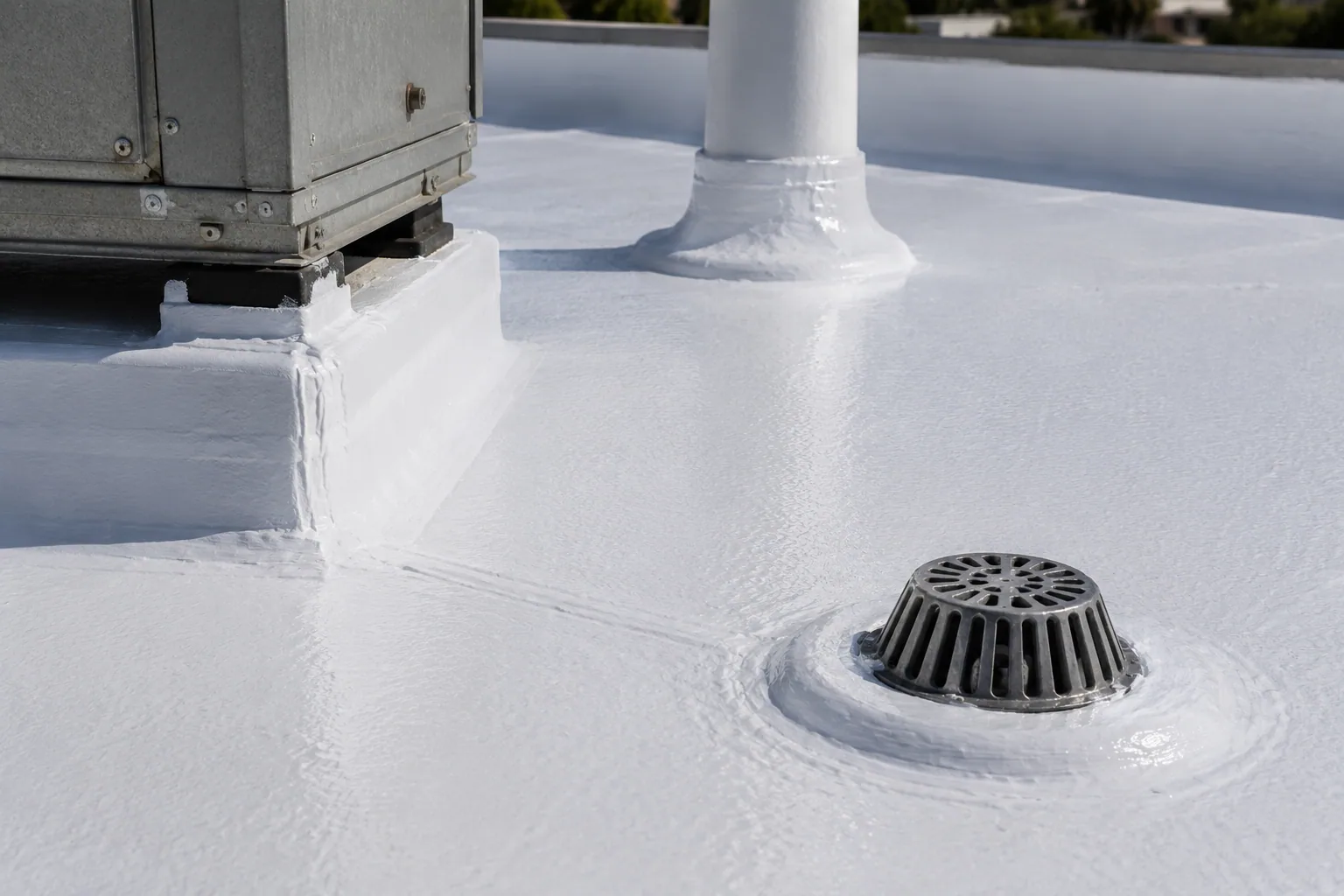
TPO Roofing in Dearborn, MI
A low-slope office, clinic or distribution building with a white single-ply roof is very likely wearing TPO, and the condition that changes the decision is almost always the seam. TPO is a thermoplastic membrane whose overlapping sheets are fused with hot air, so a welded seam either becomes one continuous layer or it does not. In Dearborn, MI, those seams spend months under snow, meltwater and freeze-thaw movement, with 30.8 inches of snow in an average year, nearly all of it between November and April.
Our first look is at the whole assembly, from membrane and insulation down to deck, then outward to edges, curbs and drains. Each is recorded on the roof plan with its condition and a photograph, so the findings can be read by someone who has never been on the roof. Then we check the welds in sequence and tell the facility director whether the roof needs a repair, a recover or a replacement, and what each choice leaves behind.
Seams, Welds and Probing
A good weld is checked by hand. We run a probe along each seam, feeling for a gap or a soft edge, and we photograph any lap that lifts. Contamination during installation, moisture on the sheet or a weld made at the wrong temperature can produce a seam that looks fine and fails early. Thermal movement later opens seams that were marginal on the first day.
On an existing TPO roof, open seams, pinholes at weld ends and cracked corners are the first things we map. A seam failure repair reheats and presses the lap, adds a cover strip or patches the corner. The repair boundary is drawn on the roof plan so the owner can see where the work stops.
Corners and T-joints, where three layers of sheet meet, are the hardest welds to make and the first to open. Prefabricated corner pieces reduce the risk, and we check every one. Around curbs and pipes, the membrane is flashed with welded boots or field-formed details, and those transitions are where thermal movement concentrates. A crack in a flashing weld at a curb is a different repair from an open lap in the field, and the record keeps them apart.
Snow, Ice and Freeze-Thaw on a Single-Ply Roof
Heating degree days total 4,027 at the Dearborn station, whose mean annual temperature is 49.5 degrees, and the NWS Detroit record puts the typical first measurable snow near November 16 and the final one near April 7. A roof here carries snow for months, and every thaw sends water toward drains that may still be frozen. Ponding that forms during a thaw puts continuous water pressure on seams, and ice can lift flashing and edge metal.
TPO handles cold when properly formulated and installed, but cold slows installation. Welding and adhesives have temperature limits, so the main installation window runs through the warmer months. Winter is for drainage checks and temporary repairs. After a heavy snow, we look at drain bowls, scuppers and the low areas where meltwater collects, because the first sign of trouble is often a stain on a ceiling tile several days into a thaw. January and February normals average 14 inches and 12.5 inches of snow in the NWS Detroit record, so a roof can see two feet of snow before the end of winter. Snow drifts against parapets and rooftop equipment, loading one part of the roof unevenly and sending meltwater along a single path.
Adhered, Fastened or Ballasted
Fully adhered TPO is bonded to the substrate and suits roofs where a smooth surface and good wind performance matter. Mechanically fastened TPO is secured by plates and screws along the seams, which is quicker and tolerates cooler weather. Ballasted systems rely on stone or pavers and need a deck that can carry the weight.
The choice follows the deck, the access, the building's tolerance for noise and odor, and the budget. Fully adhered work needs a clean, dry, firm substrate and moderate temperatures, while fastened work needs a deck that holds a screw, and the pull-out test on a few fasteners tells us which approach the deck can support. The written scope names the attachment and the reason for it, so the facility director can compare the cost of each approach.
Recover or Replacement
TPO can be laid over an old roof as a recover, provided the insulation tests dry, the deck is sound and the code permits one more layer. A cover board separates the new sheet from the old surface. When moisture has spread, a full replacement removes the old system to the deck.
On the code side, the 2021 Michigan Building Code took effect on April 9, 2025, and the 2021 Michigan Commercial Energy Code followed on April 22. Energy-code requirements can affect insulation on a tear-off, so we confirm with the local enforcing authority before the thickness is set.
TPO Beside PVC and EPDM
PVC is welded like TPO and resists grease and chemicals better, at a higher cost. EPDM is a rubber sheet with adhesive seams, a long record in cold climates and simple repairs. TPO sits between them on price and is common on large, plain roofs.
We lay out installed cost, expected service life, repair method and warranty terms for each, and the facility director chooses. The manufacturer's warranty depends on installation to its details, so we read the terms before the order and tell the facility director which inspections and records it asks for. The closeout file holds the weld test results, the photographs by roof section, the product data and the follow-up date.
Wet Insulation Sets the Boundary
A TPO roof can leak at a seam and carry the water a long way below the sheet. Trapped water shows up on an infrared moisture survey, cores verify it, and the outline of the wet zone turns into the repair limit. Repairs on the surface will not hold over a wide wet area, and the scope will say so.
Aged TPO can chalk and lose some surface flexibility, and walkways worn to the scrim near rooftop units show where service traffic has taken its toll. Walkway pads welded along those routes protect the field of the membrane, and a test weld on aged material shows whether new patches will bond. If they will not, the scope changes from repair to recover or replacement.
Where TPO Is Found Around Dearborn
Big, plain low-slope roofs are the usual candidates, and Dearborn has plenty of that kind of building, from commercial blocks in the East and West Downtown districts on Michigan Avenue to the office and mixed-use projects in Fairlane and Midtown. Manufacturing, health care, education and professional services supply over 70 percent of local jobs, so the building mix is broad, and what a given building actually has gets settled on the roof. In West Downtown Dearborn and along the Warren Avenue corridor the same seam-first check applies, as it does in Detroit and Lincoln Park.
Commercial Roofing Questions
How thick is TPO usually?
Thickness depends on traffic, attachment and warranty. The scope sets it from the roof's use and the manufacturer's requirements.
Can TPO go over an old roof?
As a recover, yes, if the insulation is dry and the deck is sound. A cover board separates the layers.
Why do some TPO seams fail?
Contamination, moisture or the wrong weld temperature, and later thermal movement. Probing along each seam finds most of them early.
Is white the only color?
No. White is common for reflectance, and the energy code and cooling load decide whether it matters.
When is TPO installed in Michigan?
Mostly in the warm, dry months. Mechanical attachment can extend the season a little, and the schedule states the weather holds.
Schedule an inspection of the roof
Send the roof age, past leak locations and access details. We will inspect, test the insulation and document the seams, so you can decide between repair, recover and replacement.