
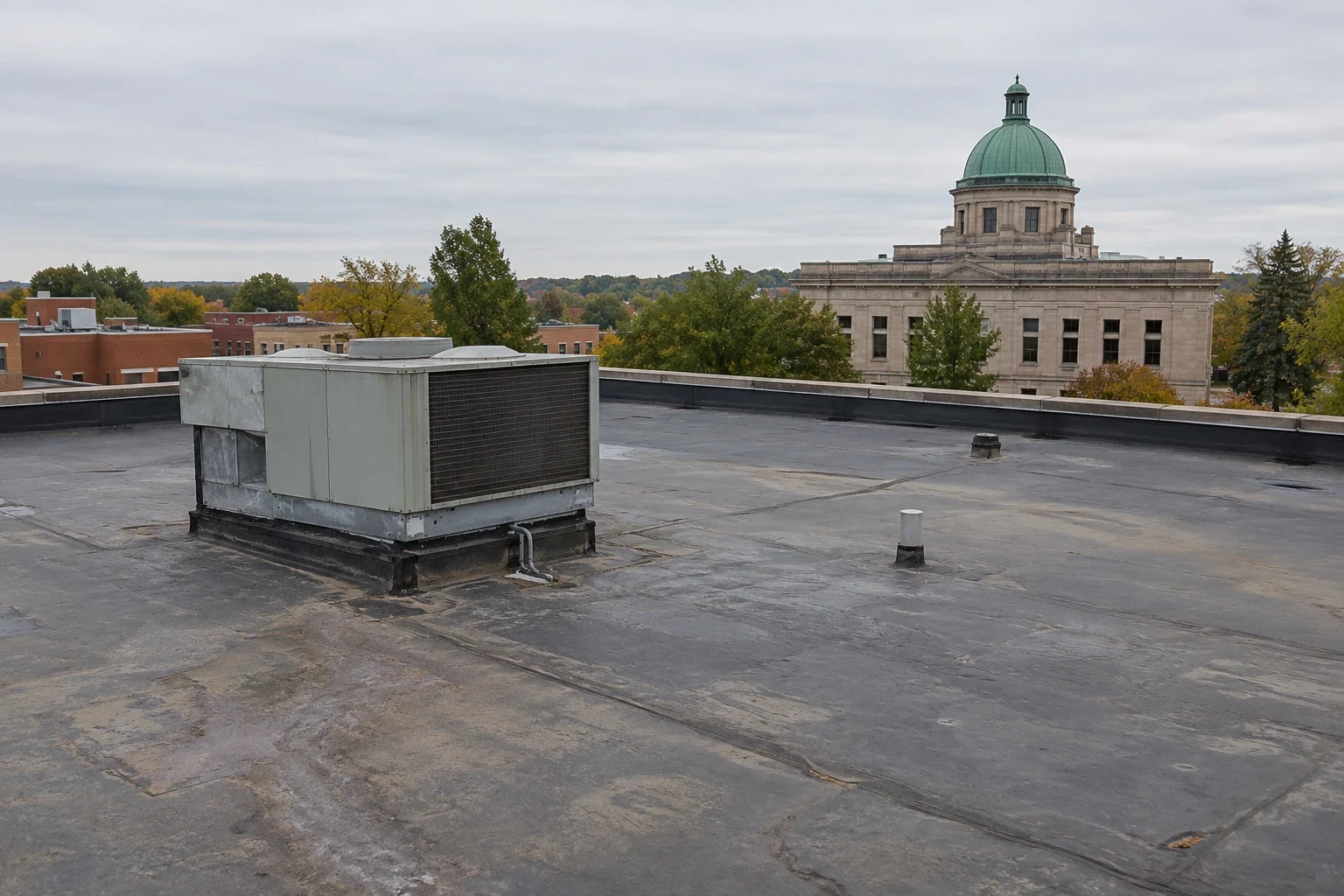
Government Building Roofing in Dearborn, MI
Municipal buildings answer to two audiences at once: the people who use them and the people who pay for them. A city hall, a library, a fire station and a public works garage each have a roof, and each roof has to be explained to a council, an auditor or a resident who asks why the money went where it did. In Dearborn, MI, the city's 2025 audited report describes business-district facade and corridor improvements alongside redevelopment, public spending that residents can see on the street.
For that reason, a public roof starts with a record that anyone can read. The record names each roof section, states what it is made of, shows its condition in photographs and gives a remaining service life. A council member who has never been on the roof should be able to follow it.
A Mixed Portfolio of Building Types
A public portfolio rarely has one kind of roof. An administration building may have a low-slope membrane over offices. A library may have skylights and a clerestory. A fire station has a steep roof over living quarters and a flat roof over the apparatus bay. A maintenance garage may be a simple metal building. Each type needs different inspection points and different repair methods, and the portfolio plan keeps them in one list.
We rank sections by condition and consequence. A leak over a records room or a dispatch console outranks a leak over a storage bay, even when the membrane defect is the same. The ranking goes with the written findings so the capital committee can see why one roof comes before another.
An administration building with rooftop units and interior drains follows the pattern of an office building roof, while a garage or storage building is usually a simple structure where fasteners, laps and gutters are the main concerns. Matching the inspection to the building type keeps the cost of the survey in proportion to the risk. A small garage does not need a moisture scan; a records building does.
Downtown Authorities and Corridor Work
Two Michigan Avenue downtown districts in Dearborn are managed through development authorities, and the Dix-Vernor corridor in the South End has an improvement authority focused on infrastructure and streetscape. When a public building sits in one of those districts, roof work may coordinate with streetscape or facade projects. A parapet or canopy repair is easier when scaffolding or a lift is already planned for facade work.
The West Downtown and East Downtown districts include historic architecture and storefronts, so edge metal, coping and flashing are chosen to match the building. Photographs of the roofline before and after go into the file. For a building shared with a private tenant, the record separates what the city owns from what the tenant installed.
Writing the Scope for Public Review
A public scope is read by people who were not on the roof, so each line is numbered with a section, a condition, a method and a quantity. Photographs attach to the line they support. When the city prepares a bid package, the lines move into its format without rewriting, and when a sole-source repair follows a storm, the same scope supports the justification the city has to write.
Unknowns are listed separately, with a unit rate for the possible extra work. A roof condition report in this form gives the council a ceiling for the unknowns before the contract is signed, not after the roof is opened.
Access gets its own line. The scope states where the crew parks, where materials stage, which entrance is used and which areas must remain open to the public. A courthouse, a records office or a council chamber has hours when hoisting and deliveries cannot happen, and those hours are entered with the name of the person who set them. When the city runs a public meeting calendar, the plan refers to it and moves noisy steps around scheduled sessions.
Codes and Energy Requirements
Two state codes govern this work: one that took effect April 9, 2025 for buildings and a second that took effect April 22, 2025 for commercial energy use. A replacement may need added insulation depending on scope, and the extent of a recover is limited by structure and code. We ask the local enforcing authority for its requirements before the scope is final and mark the lines that depend on the answer.
Roof-mounted equipment rules vary by city. Hamtramck's downtown ordinance, for example, requires roof-mounted appliances to be screened from view, which shows how local rules can change equipment placement. A city project should check its own district rules before adding or moving rooftop units.
Snow, Storms and Emergency Response
Snow totals 30.8 inches a year at the Dearborn station, and the last measurable fall in the Detroit record comes near April 7. Southeast Michigan saw damaging winds, large hail and tornadoes in September 2026, as documented by the National Weather Service. Public buildings that serve as emergency facilities cannot wait for the next budget cycle to fix a known leak, so the record includes a priority list for the roofs that must stay dry in a storm.
After severe weather, a post-storm walk logs lifted edges, displaced equipment and bruised membrane, and the findings separate storm damage from wear. Roof drains and scuppers are cleared before winter and checked after the first thaw.
Warranty inspections follow a schedule that the manufacturer sets. Missing one can void coverage, so the file lists the dates and the person responsible. A yearly walk after the spring thaw is a sensible companion, since cold-season damage shows up as open seams and loosened flashing, and a short repair then costs far less than a winter of leaking.
Capital Planning and Procurement
Cities often fund roofs through capital plans that span several years. A roof capital plan orders sections by condition and consequence, spreads cost across budget years and avoids emergency pricing. Public agencies that manage schools, offices and garages together can place all of them on the same schedule, with school buildings given the calendar planning a school roof needs.
Age records are used with care. The date of the last replacement says when a roof entered service, but it does not say how the roof has aged, because shade, drainage and rooftop equipment change wear from one section to the next. Condition is read from the surface and the moisture map, and age is kept as one entry among several. That distinction helps when a council must choose between repairing a section with years left and funding its replacement early.
Closeout completes the record. The city receives the as-built roof plan, product data, test results, photographs by section and warranty papers, all indexed to the scope lines, with the next inspection date entered on the facilities calendar.
Commercial Roofing Questions
How should a city rank its roofs for replacement?
Rank by remaining service life and by what sits beneath the roof. A leak over records or dispatch equipment outranks one over storage. We build the list from inspection findings and update it each year so the capital committee has current numbers.
Can the scope fit our bid package format?
Yes. Each line carries a section, condition, method and quantity, so it moves into a bid schedule without rewriting. The city's front-end documents govern the rest of the package.
How are unknown conditions handled in a public contract?
They are listed as open questions with a proposed unit rate for the possible extra work. The council sees a ceiling before award, and each added item is tied to a photograph taken when the roof is opened.
What if a building is in a historic district?
Edge metal, coping and flashing are chosen to match the building, and the district authority is consulted where its rules apply. The photographs of the roofline before and after go into the file.
What documentation does an auditor expect?
The numbered scope, dated photographs, test results, change orders and closeout papers. We assemble them in a single folder indexed to the scope lines so the auditor can follow any item from need to completion.
Schedule a public building roof inspection
Send the building list, any condition reports and the access rules for each site. We will inspect the roofs, record findings in writing with photographs and give the city a ranked list and a scope format that fits its procurement documents.
