
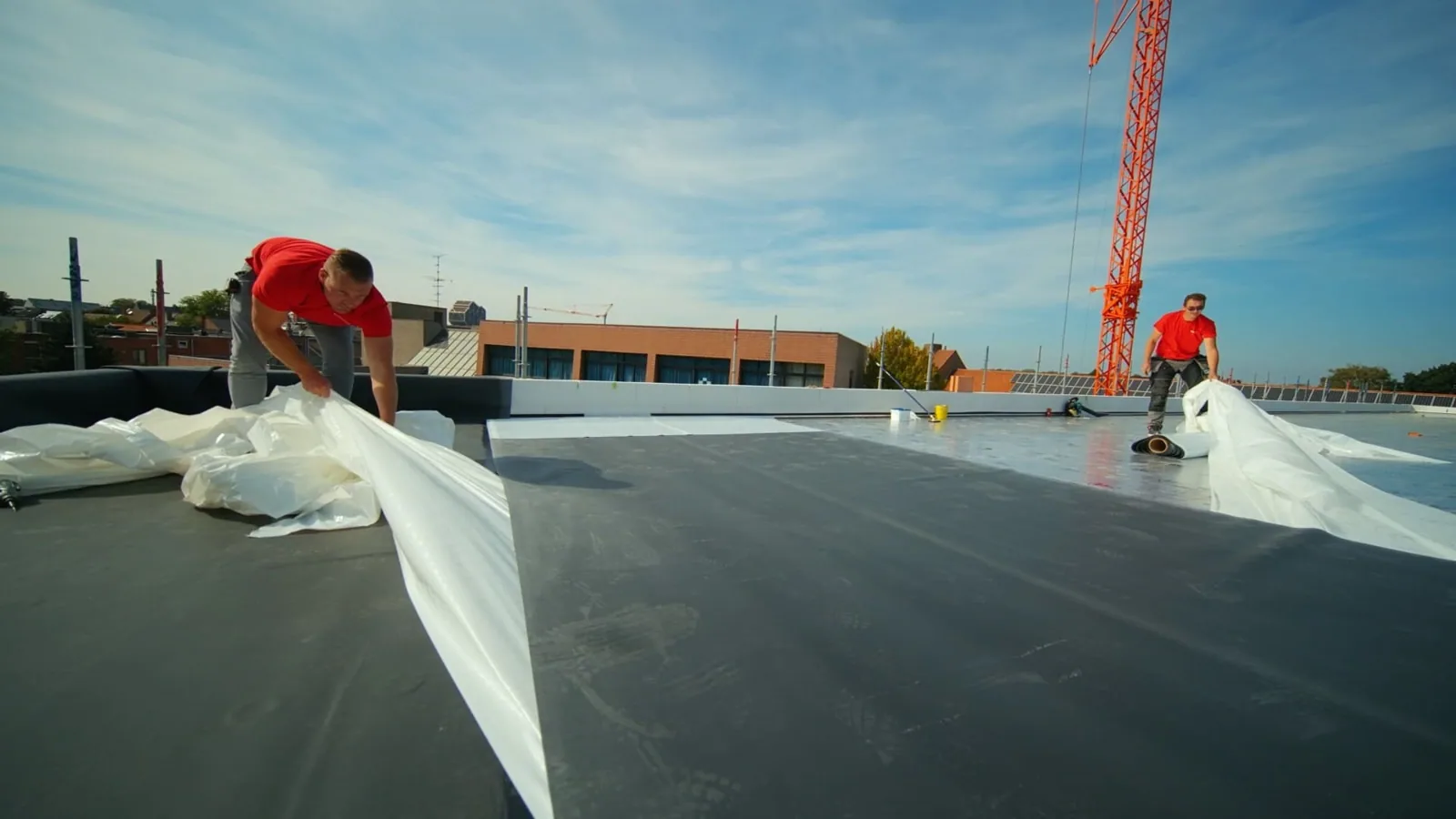
Holcim Elevate Roofing Systems in Dearborn, MI
A manufacturing or logistics building with a single-ply roof carries its paperwork under the name that was current the day the roof went on. Holcim Elevate was formerly Firestone Building Products, so a warranty certificate, a bid or an invoice in the building's files may use the earlier name while the roof is the same system. The first task on such a building is to match the paper to the membrane, because a search under the wrong name ends at the wrong answer.
Holcim Elevate offers single-ply membranes, roof insulation and accessories for commercial buildings. Dearborn, MI is described by the city as an employment center in Metropolitan Detroit, with manufacturing, education and health care among its largest sectors. Roofs of these types are common ground for the work there. The detail that controls the first decision is whether the file and the roof describe the same assembly.
Matching the File to the Roof
We gather what exists: certificates, installation papers, past bids, invoices and any roof plan. Then we compare them with the roof. The seam type, surface, fastening pattern and flashing details usually identify the family, and a core cut settles the layers when the evidence is thin.
Where paper and roof disagree, the written findings show both. A certificate may describe a membrane that a later recover has covered, or a repaired section may use a different material from the rest. The findings sort these into confirmed and unconfirmed items, so the owner knows what the file actually proves and what needs a test.
Roof age is entered only when a document gives it. A visual guess is recorded as an estimate and labeled that way, because an estimate that looks like a fact will be repeated. Where the installation year is unknown, the remaining service life is judged from condition: seam strength, surface wear, flashing state and moisture readings.
EPDM and TPO in Cold Climates
A mean annual temperature of 49.5 degrees Fahrenheit and 4,027 heating degree days make for a long cold season on low-slope roofs and rooftop equipment. An EPDM sheet stays flexible in the cold but can shrink at terminations as it ages. A TPO sheet stiffens in cold weather, so welds at low points and corners see the greatest movement.
We probe welds and test taped laps, look for flashings that have pulled from walls and check fastener plates for backing out. In winter, repairs use temporary seals until temperatures and dry surfaces allow permanent work. The findings label temporary work as temporary and set a date for the permanent repair.
The sequence for a seam repair is the same on both families. Clean the area, test the surrounding laps, make the repair with the compatible method and photograph it. Then probe or pull-test the finished seam and write the result beside the photograph. A repair that cannot be tested is flagged for the owner.
Insulation Thickness and the Energy Code
Under the membrane, insulation boards control heat loss and often shape the drainage when tapered. Two 2021 Michigan codes apply: the Building Code, effective April 9, 2025, and the Commercial Energy Code, effective April 22, 2025. The energy code may reach a roof replacement and its insulation depending on scope, and the local enforcing authority confirms the requirements before work.
For that reason, the scope names the insulation type, thickness and cover board and notes the code basis as a project-specific item. A recover over existing insulation adds height at walls and curbs, and the plan shows the new heights. The owner sees the cost of meeting the code before approval, not after the permit review.
Moisture is the finding that changes the choice. A meter pass or an infrared survey maps wet and dry zones, and a test cut confirms the reading and shows the insulation type. Dry insulation keeps the repair and recover options open. Wet insulation sets a tear-off boundary around the saturated area, and the rest of the roof can be considered separately.
Rooftop Equipment on Industrial and Commercial Roofs
Process exhaust, make-up air and heating units are common on manufacturing and logistics buildings. Each sits on a curb, and each curb is a place where the membrane is interrupted. We check the height of the base flashing, the corners and the termination, and we look for stains that show discharge landing on the surface.
Exhaust that carries oils or chemicals can soften some membranes, so the findings map affected areas and recommend splash pads or curb extensions where discharge lands. Service routes get walkway pads if the membrane is scuffed. A manufacturing plant roof or a warehouse roof is walked in the same sequence: perimeter, field, seams, drains, curbs and equipment.
Roof access hatches, ladders and stair penthouses carry their own flashing, and these are checked as part of the walk. A hatch curb with an open corner will leak into a stairwell, and a stair penthouse wall that meets the roof is a termination like any other.
Edges and Severe Weather
Damaging winds, large hail and tornadoes crossed Southeast Michigan in September 2026, including an EF-0 tornado in Lincoln Park and an EF-2 tornado in Detroit, and storms like those are the reason for a post-storm inspection. After a storm, the walk starts at the edges, where wind lifts metal and membrane, and moves to the field for hail marks.
Hail can leave dents, bruises and punctures that are hard to see, so soft spots get probed and tested for moisture. A hail damage record with dated photographs supports an insurance conversation, and edge metal goes back with the fastening pattern the system detail calls for.
Warranty Terms and Comparison
The certificate behind a Holcim Elevate roof, or the Firestone one before it, is read before any alteration that could matter, and visit logs, photographs and work orders go into the closeout file. Owners in Allen Park, Taylor and Dearborn can compare an existing assembly with Carlisle SynTec or Sika Sarnafil alternatives using the same findings.
Cold-season exposure sets the review calendar. With measurable snow typically running from about November 16 to April 7, a fall walk before mid-November and a spring walk after early April frame the winter. Each walk adds a dated entry to the file.
Commercial Roofing Questions
My roof papers say Firestone. Is that the same as Holcim Elevate?
Holcim Elevate is the name that replaced Firestone Building Products. Search for the roof under both names, record both in the file and match the certificate to the membrane before you ask the manufacturer about coverage.
What should I check on a single-ply roof before winter?
Drains and scuppers, seams at low points, wall terminations and fasteners at the perimeter. Photograph each from fixed positions, and repeat the walk after the first thaw.
Does a new roof insulation requirement apply to a recover?
It can, depending on scope and on the local enforcing authority. Confirm the requirement before approving the figure, and have the scope name the insulation type and thickness.
How do I tell hail damage from age on a membrane?
Hail marks are fresh and clustered on the exposed side, often with bruising or punctures in a pattern. Age shows as uniform chalking. Record both with dated photographs.
Can process exhaust damage a roof surface?
Yes. Oils and chemicals can soften or stain some membranes. Map where discharge lands, test the surface and add splash pads or curb extensions where needed.
Schedule an inspection and send the paperwork under either name
Send the certificate, the roof plan and any invoices, whichever name they carry. We will match them to the roof, document each section in written findings and state which repair, recover or replacement the record supports.