
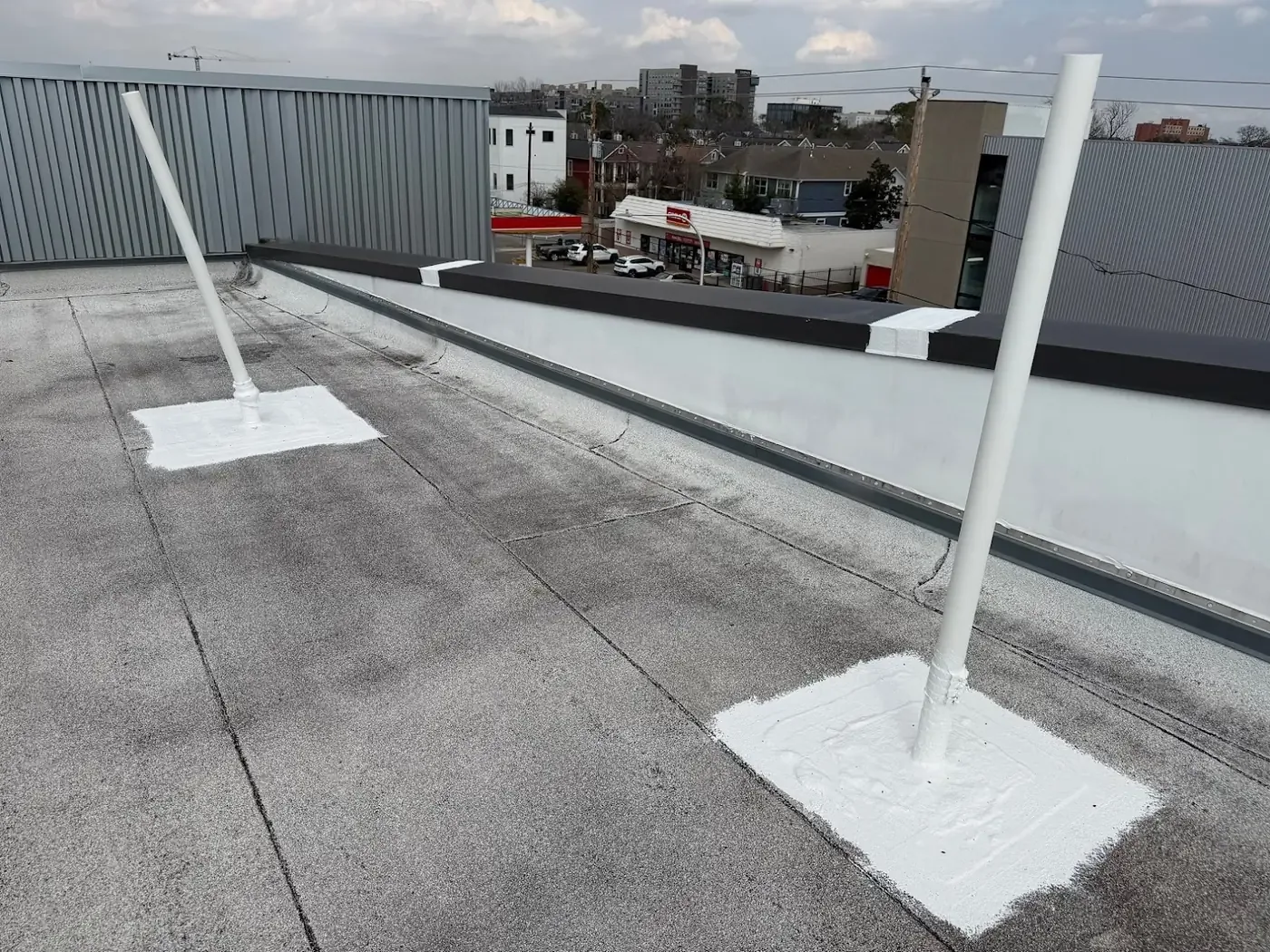
Hail Damage Roof Repair in Dearborn, MI
A hailstone does its harm to the membrane field, and which kind of roof is under that field decides what the harm looks like. On a smooth single-ply sheet over firm cover board, hail may leave a faint bruise and nothing more. On the same sheet over soft insulation, it can fracture the sheet from below. On an aged modified bitumen roof, it can knock granules loose and expose the reinforcement. Hail damage repair in Dearborn, MI therefore starts with identifying the roof assembly, then testing for the specific damage that assembly can show.
The first check is a defined test area. We mark squares on the roof, count and photograph the impacts inside each, and compare them with the surrounding field.
The Regional Record and the Roof
A National Weather Service write-up from September 2026 covers damaging wind, large hail, and tornadoes over Southeast Michigan. For an owner, the practical meaning is a reason to inspect: a roof in the metropolitan area after a severe-weather event deserves a walk, with dated photographs, whether or not a claim follows.
The roof then answers the specific question. Fresh impact marks have a different look from old wear. Bright scuffs, clean fractures, and random scatter across the exposed field suggest a recent event; uniform weathering along a traffic line suggests age. We record both and keep the causes apart in the findings.
Test Squares and the Pattern of Impact
On a large roof, hail marks are counted in test squares placed in representative areas, and in each exposure of the roof. Counts are made by section, since a roof that faces open sky shows more impacts than one shielded by a taller wall. We photograph each square with a scale and note the number, the size, and the condition of each mark: bruise, fracture, puncture, or granule loss.
Patterns matter. Impacts concentrated on one side suggest a wind-driven event. Even scatter suggests falling stones. Soft metal items on the roof, such as vent caps, gutters, and unit housings, record dents that help gauge the event; we photograph them even when they are cosmetic, since they corroborate what the sheet shows. The test squares go on the plan so a second inspector can find them.
How Each Roof Assembly Shows Hail
Single-ply sheets, TPO among them, can show round bruises or fractures where the sheet sits over soft insulation, and hail can also damage a sheet that was already brittle. Rubber sheets can show punctures or crescent-shaped splits. Modified bitumen and built-up roofs show granule loss, fractured surfacing, and blisters raised by impact. Metal roofs show dents and, in some cases, coating damage at the dent. Foam roofs show crushed or cracked surfaces, and coatings show chips.
The question is always whether the mark has broken the water barrier or weakened the assembly, and a roof that also carries punctures from foot traffic, as in a membrane puncture repair file, needs those marks kept apart from the hail. A bruise that has not cracked the sheet may be cosmetic. A fractured sheet is a leak path. We probe, press, and, where needed, take a core to see whether the insulation beneath is crushed or wet.
Moisture Below the Impact
Hail can open small paths for water that do not leak for weeks. Wet insulation reveals itself with a scan, and cores at the marked points confirm it. A dry core under a fractured sheet supports a local repair. A wet core across a wider area changes the scope toward replacement of insulation and sheet in that area. A moisture survey after a storm is therefore worth doing even on a roof that is not yet leaking, since it settles the question while the cause is still fresh.
Rain and snow fall on roughly nine to twelve days in most months at the Dearborn station, which adds up to about 35 inches a year, so an opening left unrepaired is rained on soon.
Buildings That Show Hail Differently
A hail event does not treat all buildings alike. Large, flat roofs such as those on warehouses and plants present the most surface to falling stones and show the most marks, though the damage per square foot may be low. Roofs on older commercial buildings along the Michigan Avenue downtown districts and the Warren Avenue corridor, where the city lists retail, food service, pharmacy, and medical-office uses, are worth checking around the equipment and signs that sit on them. A school or college building mixes ages, so one roof section may be recent and another near the end of its remaining service life, and the same stone does different things to each.
For those mixed roofs, we rate each section separately. A new sheet over firm board may need only a count and a note. An old sheet over soft board may need a repair, and one beyond service life may need replacement regardless of cause, in which case the findings separate the portion linked to the storm from the portion that age would have required anyway. That separation is useful to the owner whatever an insurer decides.
Skylights and rooftop units get their own check, and any water path they opened is traced.
Repair, Recover, or Replace
If the same event also lifted edge metal or tore a sheet, the inspection method for wind damage runs alongside it. A few fractured spots on a sound roof are repaired by patching, and each patch is photographed and located on the plan. A widespread pattern of fractures on an aged sheet may push the scope toward a recover or a replacement, depending on the moisture finding and the remaining service life. A storm damage repair scope sets out each option with its cost and the evidence for it. Where metal items are dented but intact, the findings say so, and the owner decides whether cosmetic damage matters for the building.
Cost depends on removal depth, insulation condition, area, access, and the work window. Dearborn roofs also face winter, so a repair late in the season may be temporary until the weather allows the permanent work.
Documentation for an Insurance Claim
An insurer expects dated photographs, a plan, and a description of the damage separated from age-related wear. Our file includes the test squares, the counts, photographs of representative impacts, the moisture map, and the proposed scope. We do not say what a policy covers. We provide the roof side of the record, and claim documentation support helps organize it. A drone survey can add overall images of a roof that is hard to walk, with each image numbered to match the ground photographs.
Owners in Lincoln Park, Detroit, and other Southeast Michigan cities that appear in the regional storm record can use the same file format for their buildings.
Commercial Roofing Questions
How is hail damage confirmed on a commercial roof?
By test squares, photographs of each impact, probing of the sheet, and moisture scans where the surface suggests trapped water. The count and condition of marks in each square go into the written findings.
Does every hail mark mean a leak?
No. A bruise that has not cracked the sheet may be cosmetic. A fracture, puncture, or crushed insulation is a different matter, and the findings separate them.
How do you tell recent hail from old wear?
Fresh marks are crisp and scattered across the exposed field, while old wear follows traffic lines or exposure. Dented soft metal items support the finding. The photographs record both.
When does hail damage push a roof toward replacement?
When fractures are widespread on an aged sheet, or when moisture tests show wet insulation across a large area. The findings state where the repair stops and the evidence for it.
Can a drone survey replace a walk after hail?
It documents areas that cannot be walked safely, but it does not probe fractures or test moisture, so every section that can be reached still gets walked.
What should be done first after a hailstorm?
Photograph visible damage, protect any opening, and schedule an inspection while impact marks are fresh. Dated records help with any claim.
Send the storm date and any photographs
Send the date of the event, the building address, photographs of damage or leaks, and the access window for the roof. We will document the condition with test squares and written findings, and state what evidence will support the repair boundary.