
PVC Roofing in Dearborn, MI
A restaurant, a food plant or a building with heavy exhaust has a roof that is exposed to more than weather, and the condition that changes the membrane decision is what settles on the surface. PVC earns its place on those roofs because it resists grease, oils and many chemical residues better than several other single-ply membranes. On a plain office roof it competes on seam strength and service life with TPO and EPDM, and the choice becomes a question of cost, exposure and how often the owner wants to be on the roof.
In Dearborn, MI, the city's named headquarters employers include Shatila Food Products alongside Ford Motor Company, Carhartt and Hollingsworth, and its major industries include manufacturing, education and health care. A roof is read from its exhaust locations, the staining and the condition of the seams, and we write down what we see.
The first deliverable is a map, drawn on the roof plan and photographed section by section: roof sections, exhaust and vent points, drains, curbs, and each area where staining or softening shows. With the map in hand, the facility director can see whether the roof's problem is the membrane, the way the building discharges onto it, or both. Fixing the membrane while the exhaust keeps dumping on it is money spent twice.
What PVC Is and How It Ages
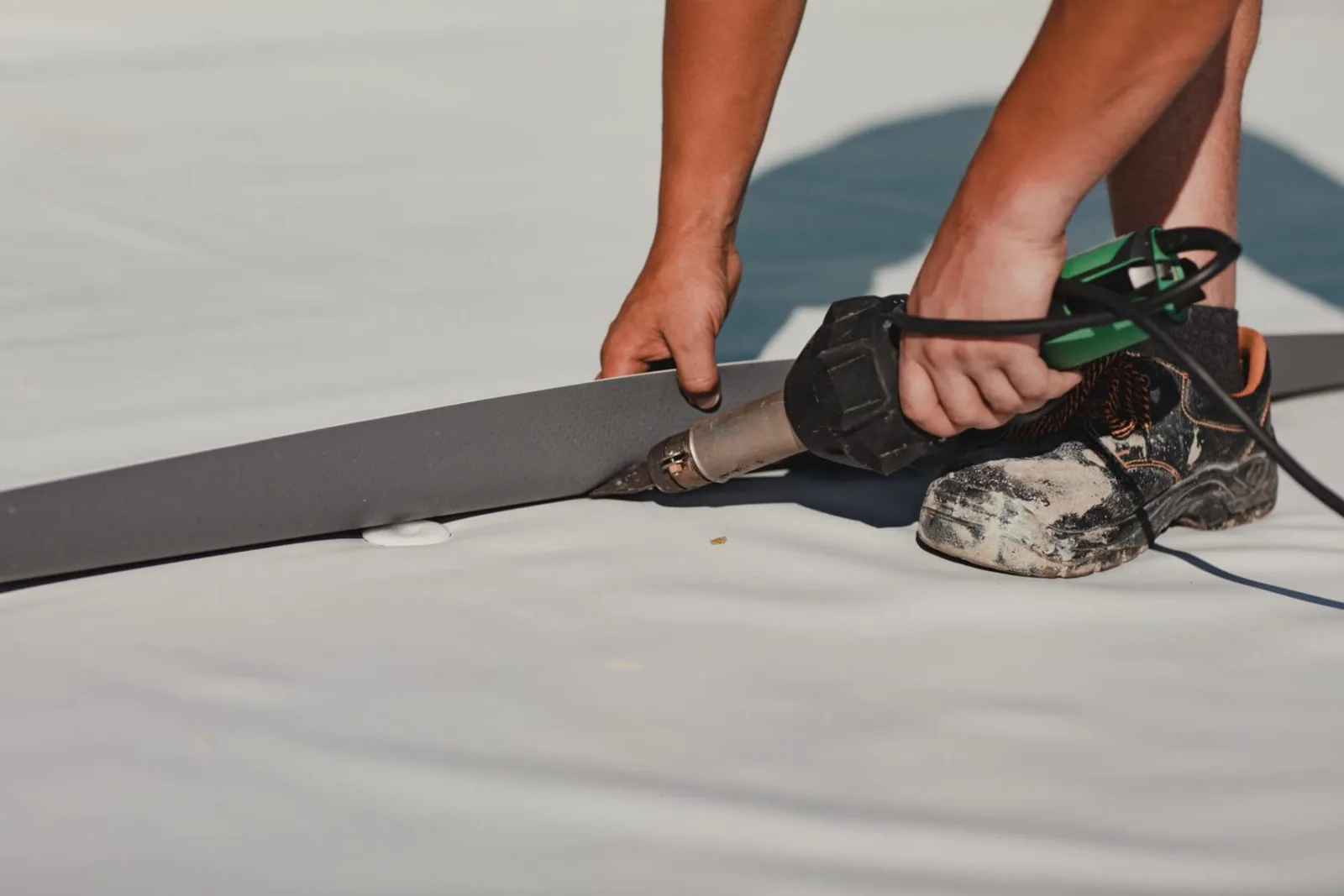
PVC roofing is a polyvinyl chloride sheet, reinforced with polyester or fiberglass scrim and formulated with plasticizers that keep it flexible. Sheets are joined by hot-air welding, which fuses the overlapping surfaces into a continuous membrane. Thicknesses commonly range from 50 to 80 mil, and the membrane is often white, though other colors exist.
Plasticizers are the maintenance topic. Over decades they migrate out of the sheet, and the membrane stiffens. A roof beside heavy exhaust can age faster. We measure flexibility on inspection by bending a test patch and watching for cracking, and we record the result so that change is visible from one visit to the next.
Grease, Oils and Exhaust
Kitchen exhaust, process vents and some cleaning chemicals attack many membranes. PVC with the right formulation resists them, which is the main reason it is specified near kitchen exhausts and industrial vents. Grease still needs managing, and it is the owner's housekeeping as much as the roofer's repair: filters on the exhaust, cleaning of the membrane around it and walkway pads along service routes keep deposits from building up and keep the surface from becoming slippery.
We note every exhaust location on the roof sketch, record grease staining and photograph it. Should grease reach a seam or flashing, the plan calls for a compatible cleaner first and new details wherever the old ones have gone soft. A restaurant roof is the clearest case, though process vents on a food plant or laboratory put the same question to those roofs.
Cold Season Handling
Snow adds up to 30.8 inches a year at the Dearborn station, which also logs 4,027 heating degree days. The snow season typically opens around November 16 and closes near April 7, which leaves a PVC roof carrying snow and ice for months. A reinforced, welded sheet handles movement at seams if the details are well made, and ice that blocks drains is the usual threat.
Cold affects installation. Welding and adhesives have temperature limits, and PVC becomes stiffer to handle in cold weather. Warm months hold the main installation window, and winter is kept for inspections and temporary repairs. Weather holds are written into the schedule with a date for the next update.
Installation Sequence and Checks
A PVC reroof follows a set order. The deck is inspected and repaired, insulation and cover board are laid, the membrane is rolled out and attached, seams are welded and probed, and flashing details are formed at every wall, curb and penetration. Prefabricated corners and boots reduce hand-welded details, and each weld is checked as it is made. Test cuts from the weld are pulled at intervals the project sets, and the results go into the file with the date and location. Probing is repeated at corners, T-joints and around curbs, because those junctions take the most heat-welding skill and the most thermal movement. Anything that fails the probe is re-welded the same day and probed again.
Cover board protects the insulation from foot traffic and impact. Where service traffic is heavy, walkway pads are welded along the route to the equipment so that wear lands on a sacrificial surface. A full replacement carries the longest schedule, and a recover over a sound base the shortest. Permits follow the state's 2021 building code, and the thickness of the insulation answers to its commercial energy code.
Repairing an Existing PVC Roof
Small failures on PVC are fixable. A cut, a split seam or a cracked flashing can be repaired with a hot-air welded patch of compatible material, provided the existing membrane is clean and weldable. A test weld shows whether aged material will bond, and the result is photographed. If the surface has been contaminated or has hardened too far, welding may not hold, and a liquid-applied flashing resin or a coating comes into play.
An infrared moisture survey maps wet insulation, and the repair boundary drawn from it sets what can be patched and what needs replacement. A roof with wet insulation over a wide area is not a patch candidate, however good the membrane looks.
PVC Compared With TPO and KEE
PVC and TPO are both welded thermoplastics. PVC generally offers stronger chemical resistance and a long record of seam strength, at a higher material cost. KEE, a PVC-alloy membrane, adds a polymeric modifier in place of conventional plasticizers to slow aging and resist contamination.
The comparison goes into the scope with installed cost, expected life and the repair method for each, and the facility director picks. Exposure and budget decide it, and the findings put the numbers side by side. A manufacturer's warranty depends on installation to its details, so terms are read before an order is placed. The closeout file holds weld test results, photographs by roof section and the follow-up date.
Where PVC Fits Around Dearborn
PVC suits roofs with exhaust and process loads: restaurants and food service, kitchens and laboratories at institutions, and manufacturing buildings. The Warren Avenue corridor, where the city lists cafes, bakeries and grocery stores, and the restaurants of East Downtown Dearborn are places where the exhaust question belongs on the checklist, and it applies in Detroit and Warren too. A plant tied to Dearborn's manufacturing base and a laboratory on the University of Michigan-Dearborn campus each get scoped from their own roof walk, since the exposure on any one building is established from the roof itself.
Commercial Roofing Questions
Why choose PVC over TPO?
Mostly for exhaust, grease and chemical exposure and for seam strength. On a plain roof the two compete on cost and preference.
Does PVC get brittle with age?
Plasticizers migrate out over decades, so the membrane stiffens. We test flexibility on inspection and record it.
Can PVC be installed in winter?
It can be handled in cold weather within the limits for welding and adhesives, but the main installation window is the warm season.
How is grease damage repaired?
The surface is cleaned with a compatible product, softened flashing is replaced and welded patches go on clean membrane.
What drives PVC cost?
Thickness, attachment method, the number of penetrations and flashings, insulation work and access.
Schedule an inspection of the exhaust and roof
Send the exhaust locations, past leak spots and roof access. We will inspect, test and document what we find, so you can choose between repair, recover and replacement.