
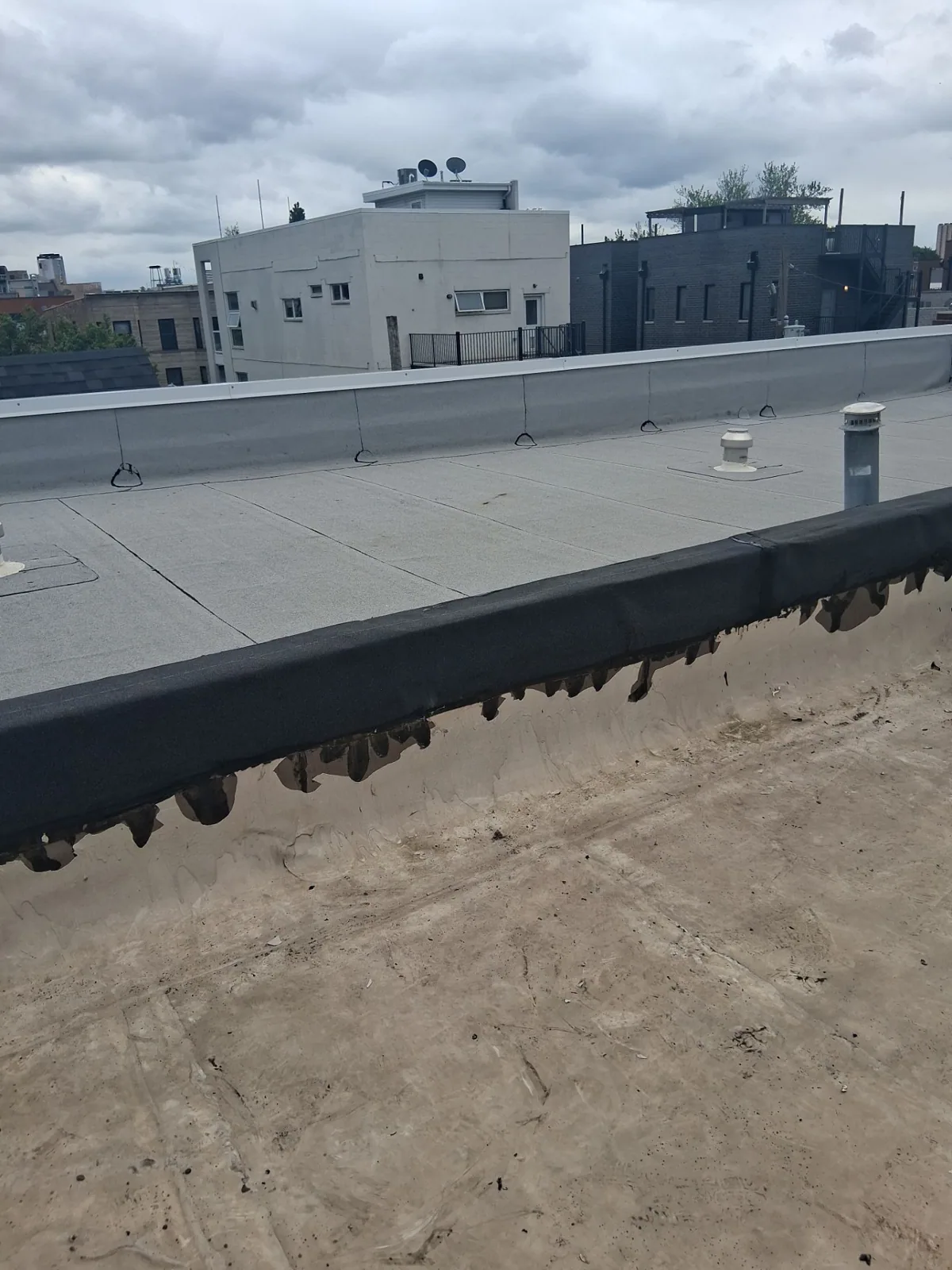
Flashing Failure Repair in Dearborn, MI
On a roof with rooftop units, a parapet, and a handful of pipe penetrations, the flashing is where a good membrane field meets everything that interrupts it. A university lab building, a medical office, and a retail center each have their own mix of those interruptions, and each one is a place where two materials meet and move at different rates. Flashing failure repair in Dearborn, MI therefore begins by naming the detail that controls the leak, and it ends with a repair that fits the roof assembly beneath it.
We check in sequence: perimeter, walls and parapets, curbs, pipes, drains, and skylights, each photographed and numbered.
Where Flashings Fail
Failures cluster at transitions. A base flashing at a wall can slip down as its attachment loosens. A counterflashing can open at a joint. A curb flashing can crack at a corner where the sheet was folded. A pipe boot can split in the sun or leave a gap when the pipe moves. A drain flashing can lift from its ring. A skylight curb can lose sealant at a corner. Each has a typical cause, and the cause decides the repair.
We map every flashing on the plan and photograph it from a fixed position, so the same angle a year later shows whether a gap widened or a termination bar lifted. The numbering lets us tell the owner that the third curb on the north side is the one that failed, not just that the roof leaks.
Causes You Can Read on the Roof
Cracked sealant points to age and movement. A termination bar with missing fasteners points to wind or traffic. A base flashing that has slipped points to attachment above it that was never adequate. A membrane that has shrunk from a curb points to material aging. Rust at a metal fastener points to moisture trapped under the cap. A boot sized for a smaller pipe points to a later change that nobody flashed. A mismatch between the cause and the repair is how a flashing fails twice.
Cold adds its own cause. The Dearborn station normals record 4,027 heating degree days and a mean annual temperature of 49.5 degrees, and NWS Detroit places measurable snow from mid-November to early April. Sealants stiffen, metal contracts, and a joint that held in July can open in January. The detail that controls on a Dearborn roof is the one that tolerates movement through that range.
Parapets, Walls, and Counterflashing
Where the roof meets a wall, two layers do the work: a base flashing that turns up the wall, and a counterflashing or coping that covers its top edge. When either layer fails, water runs behind the other. Parapet walls add the extra complication of a back face, a cap, and often a through-wall scupper, and each is a separate path for water. We inspect the base flashing for slippage, wrinkles, and open laps, the counterflashing for gaps and loose fasteners, and the wall above for cracked masonry or mortar that can feed water into the assembly.
The repair depends on what we find. A loose counterflashing is re-fastened and sealed. A slipped base flashing is cut back and replaced with a new piece set to the correct height. A cracked parapet cap is repaired or replaced, since water entering from above will defeat a perfect flashing below. If the wall itself is the problem, we describe it in the findings and refer it to the right trade, because a roofing repair cannot hold against a wall that leaks.
Height is a recurring check. A base flashing that stops too close to the membrane is vulnerable to ponding and snow buildup, and a flashing that rises well above the water line gives snow and ice less chance to push behind it. When a recover or added insulation raises the roof surface, the flashing height has to be raised with it, which is a scope item that is easy to miss.
Curb Transitions and Rooftop Equipment
Rooftop units sit on curbs, and the curb transition is a frequent leak source. Technicians walk around the unit, set down tools, and lean on the flashing, and the corner of a curb takes the worst of it. We check curb height, flashing height above the membrane, corner details, and the counterflashing or sealant at the top. A flashing shorter than the system requires is a defect from installation, not wear.
When equipment is replaced, the curb often changes too, and the flashing has to be rebuilt to match. Our work on rooftop equipment curbs and supports includes new flashing, and the record shows who opened the roof and when, so a leak that appears near a changed curb is tied to the work that changed it.
Repair Methods by Membrane
On a single-ply roof, a failed flashing is cut back to sound material and replaced with a new piece, welded or adhered to the field sheet and terminated with a bar and sealant. On modified bitumen, new flashing plies are set in adhesive or applied with controlled heat. On a metal roof, trim and sealant at the joint are replaced and clips are checked. Liquid-applied flashing resin suits awkward shapes, such as a cluster of pipes, but only over a clean, primed, sound surface.
We probe the finished termination and, where the roof allows, test the detail with water while someone watches the interior. For skylight and pipe work, skylight and penetration flashing practice applies, and the finished detail is photographed.
Tracing the Leak to the Flashing
An interior stain is not where the water got in. We match the stain to the roof above, find the flashings upslope of it, and test them with water in sequence, one at a time, starting low. The interior is watched for a drip. That method finds the flashing that failed and rules out its neighbors, so the repair is one detail and not five guesses. A leak repair built this way is smaller and lasts longer.
When a failed flashing sits next to an open lap or an aged sheet, the scope includes them. A seam failure beside a curb, or a puncture near a walk path, is added to the same visit.
Building Types and Their Flashing Loads
A campus building such as those at the University of Michigan-Dearborn, where the campus map shows engineering, research, library, fieldhouse, and parking-structure buildings, can carry many different roof levels and penetrations, each with its own flashing. A retail center on a corridor such as Warren Avenue, which the city lists with food, pharmacy, and medical-office uses, carries rooftop units and signs. A storefront building in the East or West downtown districts along Michigan Avenue has parapet flashings and counterflashings that may have been patched more than once. We record each building as found, and the written findings state which flashings are priority, which can be monitored, and which are part of a larger replacement.
Commercial Roofing Questions
Why does a flashing leak again after sealant is added?
If the joint is moving, sealant alone will not hold. The repair needs a detail that allows movement or a mechanical termination that fixes the flashing in place.
Which flashing fails most often on commercial roofs?
Curb and penetration flashings, because they combine corners, service traffic, and dissimilar materials. We number and photograph each so repeat failures are visible.
How do you find the failed flashing when the stain is far away?
We match the stain to the roof above, then test upslope flashings with water one at a time while someone watches the interior.
Can liquid flashing replace a damaged boot?
It can seal an awkward shape when applied over a sound, clean, primed surface. It does not fix a boot that is the wrong size or lacks support.
What does cold weather do to flashings?
It stiffens sealants and contracts metal, so joints that were tight in summer can open in winter. The detail has to allow for that movement.
How is a finished flashing checked?
With a probe at the terminations and, where possible, a water test. Results are photographed and added to the written findings.
Send the leak location and the roof photographs
Send the interior stain location, photographs of the roof around the suspected flashing, and any repair records, along with the access window. We will return written findings with a numbered flashing inventory, the proposed method for each, and the repair boundary.