Ponding Water Roof Repair in Dearborn, MI
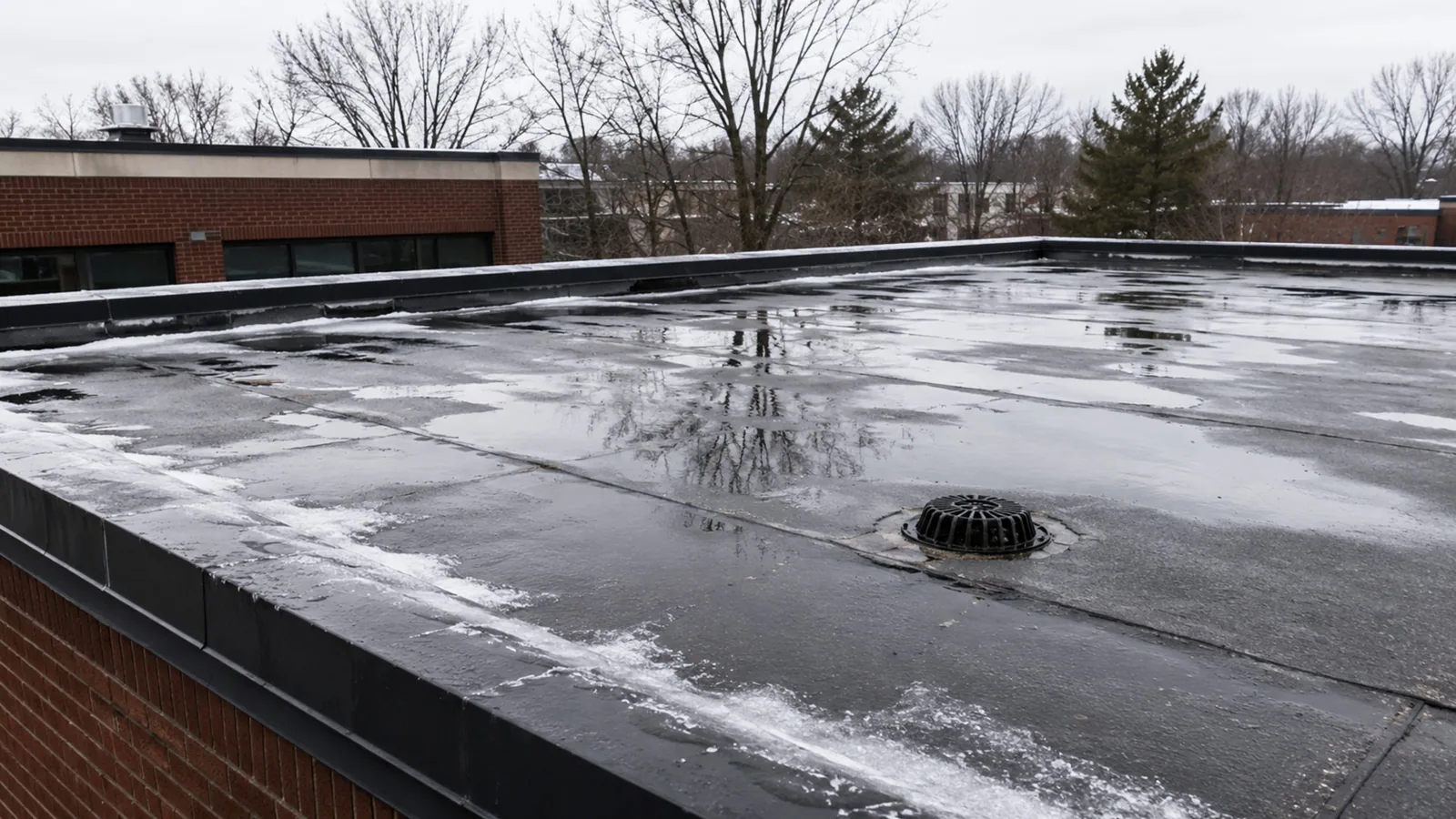
A flat-roofed medical office, a school wing, and a food-service building all hold water the same way: a low area in the membrane field that stays wet after the roof around it dries. What differs is the cost of leaving it. Over a clinic corridor, a pond near a seam is a tenant problem within one season; over a storage bay, it may be a slower problem. Ponding water repair in Dearborn, MI starts with measurement and ends with a decision about slope, drains, or the membrane.
The first check is a tape measure. We record depth at the center of each pond, its distance to the nearest drain, the date of the last rain, and the hours since it fell.
Depth, Duration, and Location
A shallow stain that dries by the next afternoon points to a surface that drains slowly. A pond that remains for days points to a low area or a blocked outlet. We photograph each with a level or tape for scale, mark it on the roof plan, and return after the next rain to see whether it grew or moved. Recording duration matters more than appearance, since a pond that appears and vanishes may be harmless, and one that persists ages the membrane and loads the deck.
Location matters too, and it helps to read it against the flashing and seam record kept for a flashing failure repair or a seam failure repair, since a pond that sits on a lap or beside a curb often traces back to one of them. Ponds at drains suggest a clogged bowl or a high drain. Ponds mid-field suggest deck deflection or compressed insulation. Ponds at a wall suggest a missing cricket or a flashing that has lifted the surface into a dam.
The Drain Bowl and the Outlet Path
Most ponds trace back to the outlet. We clear each drain bowl, photograph it before and after, check that the strainer is present, and look at the flashing ring where the membrane meets the drain. A ring set above the surrounding membrane holds water behind it. A cracked clamp or a lifted flange is a leak path as well as a drainage fault. Further down, the leader pipe may be partly blocked, which we test with water.
Where the roof has too few outlets for its area, the repair may add one, with a new bowl, flashing, and a connection to an approved discharge. Roof drains and scuppers are also checked for overflow capacity, since a roof with only primary drains can load the deck if those clog.
Cold-Season Behavior
Snow at the Dearborn station averages 30.8 inches a year and falls mostly between November and April, within about 35 inches of total yearly precipitation, and the Detroit weather office sees the season open about the middle of November and close around the first week of April. For a pond, that calendar means repeated freeze and thaw: water sits, freezes, expands against seams and flashing, then thaws and finds every small opening. The heating-degree record of 4,027 for the station reflects how much of the year the roof spends in cold conditions.
Snow adds weight, and a deck that has deflected under past snow loads can hold the pond that results. Project snow loads still need code-specific site checks, so a sagging deck goes to a structural engineer, and the roofing repair waits for that opinion.
Equipment, Traffic, and Obstructions in the Water Path
A pond does not always begin with the roof surface. A line of conduit laid across the membrane, a unit curb set across a slope, or a stack of old materials left near a drain can each dam the path that once drained. Technicians who set a ladder in the same low spot every month compress the insulation under it. We note every obstruction in the water path on the plan, with a photograph, and propose the smallest change that restores flow: a cricket behind the curb, a raised support under the conduit, a relocated ladder point, or a walk pad that spreads the load.
Snow adds a second pattern. Drifts against a parapet or a unit melt slowly, and their runoff can overload the nearest drain while the rest of the roof is dry. The two snowiest months, January at 14 inches and February at 12.5, set up the biggest thaws, and a thaw in either can send a lot of water to a few drains at once. The drain bowl nearest a drift zone is checked first, and the drift zone is marked so crews do not pile snow there during clearing.
Roofs along busy business corridors such as Warren Avenue, with its mix of food, pharmacy, and medical-office uses, can pick up rooftop equipment over time. Each addition is a chance to change the water path, which is why the record lists them by date.
Correcting the Low Area
Where slope is the cause, we build slope. Tapered insulation set under a new membrane moves water to the drains. A cricket behind a curb or a unit sends water around the obstacle. Cover board over crushed insulation restores a flat surface. Where a pond is small and the membrane sound, a local fill beneath a patch may be enough, but the written findings explain why the owner chose it over a larger correction.
Membrane type affects the answer. A rubber membrane may tolerate a pond longer than some other sheets, while a warranty may limit coverage where water stands. Wet insulation under a pond holds neither a patch nor a coating, so we check it with a moisture survey before choosing the repair.
Which Buildings Hold Water
Large flat roofs on warehouses, plants, and big-box stores hold water most often because long runs between drains leave more room for low spots. Buildings with many equipment curbs hold water at those curbs. Older storefront buildings downtown, in the districts along Michigan Avenue, may have small roofs with a single drain, where one clog creates one big pond. The city describes office and retail redevelopment in the Fairlane and Midtown area, and any roof added or reworked in that kind of project should have its drainage checked at turnover, so slope problems are found before a warranty clock runs.
For a school roof, the work area is often limited to summer, so ponds found in spring become repairs scheduled for that window. We write the access window and the repair into the plan together.
Follow-Up and Prevention
After the repair, we repeat the measurements at the same locations and compare. The record shows before and after depths, the new drain or taper, and a date for the next rain-day check. Owners who want recurring checks can add a ponding walk to a maintenance visit, so a clogged bowl is found in autumn and not in January.
Commercial Roofing Questions
How long may water stand before it counts as ponding?
Water that remains well beyond a day or so after rain points to a drainage issue worth tracing. We record depth, duration, and distance to the nearest drain, then return after the next rain to see whether the pond changed.
Is a pond always a leak?
Not by itself. It ages the membrane faster, adds weight, and exposes any weak seam or flashing. The repair depends on whether the water has found an opening or wet insulation.
Can tapered insulation fix a pond without a full replacement?
Sometimes. It goes under a new membrane, so the old sheet usually comes off or is covered by a recover, and the insulation condition decides.
What if the deck seems to be sagging?
We measure and photograph it and report it to a structural engineer. The roofing repair waits for that opinion, because adding material to a deflected deck can make it worse.
Does ponding affect a manufacturer warranty?
Some warranties limit coverage where water stands beyond a set period. The warranty paperwork should be checked, and the dated pond record supports the owner's position.
When should drains be checked in this climate?
Before the first snow, after the first hard freeze, and after the spring thaw. Each visit is photographed so changes show up side by side.
Send the pond locations and the last rain date
Send the building address, photographs of standing water, the date of the last rain, and the access window for the roof. We will return written findings with depths, a water path for each pond, and the repair boundary the evidence supports.