
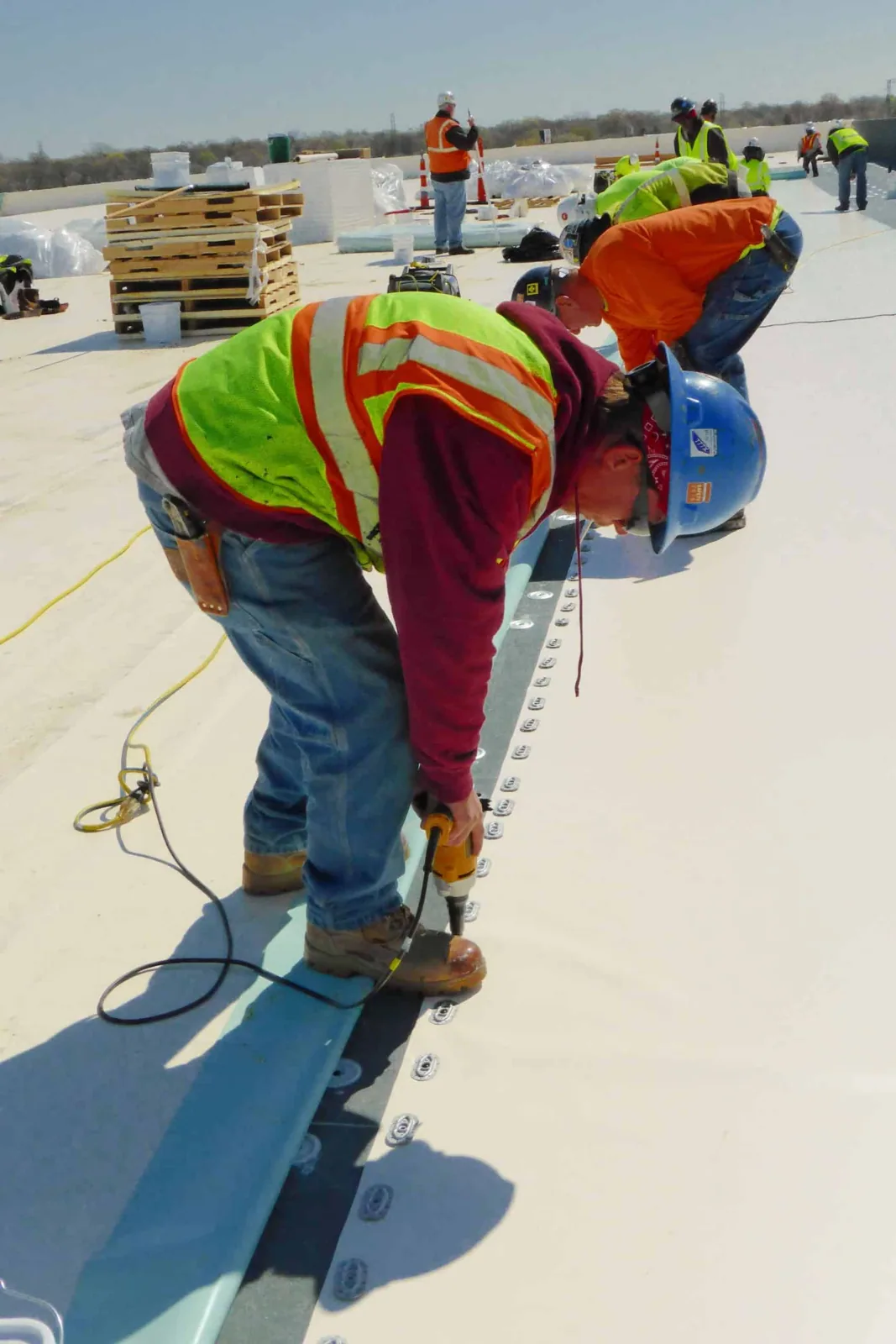
KEE Roofing in Dearborn, MI
A manufacturing or process building with heavy exhaust has a roof membrane that is working against its own building, and the condition that changes the decision is what the exhaust leaves behind. KEE is a PVC-alloy membrane built to shrug off oils, greases and chemical residues that shorten the life of other roofing sheets. Dearborn, MI, makes the question a live one, since manufacturing, education and health care, and professional services supply over 70 percent of local jobs: what lands on this roof, and will the membrane tolerate it?
If the answer includes cooking exhaust, lubricant mist or solvent vapor, KEE belongs in the comparison. If the roof carries nothing but weather, it competes mainly on price. We start with a walk, map the exhaust and vents, photograph residue and test the insulation, and then the written scope sets out repair, recover and replacement paths with their cost.
How KEE Differs From Standard PVC
KEE stands for ketone ethylene ester, a polymer blended into the PVC sheet in place of the conventional plasticizers that give standard PVC its flexibility. Plasticizers can leach out of ordinary PVC when it sits against oils or heat, and a membrane that loses them stiffens and cracks. A polymeric modifier does not migrate in the same way, so the sheet keeps its flexibility longer in contaminated settings.
The sheet is reinforced, welded at the seams with hot air and commonly white. It is more specialized than standard PVC, and the price reflects it. Standard PVC is not a lesser product: on a roof with light exposure it performs well and costs less. We price both and show what the added resistance costs. A roof with one small vent may not justify it; a roof with a dozen exhaust fans and a history of softened membrane around them may. The inspection tells us which description fits, and the staining pattern on the sheet is usually the plainest evidence.
One question comes first on any contaminated roof: is the membrane the problem, or is the problem what sits above it? A flashing that was never terminated properly, a drain that holds water for days or a vent that dumps condensate on one spot will damage any membrane. We find the cause before choosing the cure, and the roof record shows where each condition sits on the plan.
Exhaust, Oils and Process Vents
Kitchen exhaust, lubricant mist and process vapors deposit film on a roof. Film attracts dirt, softens some membranes and makes walking slippery. A contamination-resistant membrane holds up, but the roof still needs care: filters on exhaust fans, cleaning of the membrane around vents and walkway pads along service paths keep deposits from building up and reaching seams.
We record every exhaust point on the roof sketch and photograph the staining around it. If residue has worked into seams or flashing, the repair plan cleans with a compatible product and renews the details that softened. A compatible cleaner matters, since the wrong solvent can damage the sheet it is meant to clean. Drip trays or splash guards under grease outlets protect the membrane directly and cost little against a section of replaced sheet.
Snow, Ice and the Cold Season
At the Dearborn weather station snowfall totals 30.8 inches a year, mostly November through April, the mean annual temperature is 49.5 degrees and heating degree days reach 4,027. Detroit's NWS normals give 14 inches of snow in an average January and 12.5 in February. A welded, reinforced membrane handles movement at seams and edges through those months when the details are well made, and drain checks after each heavy snow are routine.
Cold slows installation, since welding and adhesives have temperature limits. Installation belongs mostly to the warm months, and weather holds are written into the schedule. Snow load on the structure is a code question, and the design professional still has to run a code-specific site check for each project. After a heavy snow we look at drains and scuppers first, then at the places where snow drifts against parapets and rooftop equipment, because uneven loading and meltwater paths concentrate there. Wind-driven debris is a second concern, and a post-storm walk checks for punctures and displaced equipment covers. A walk after any severe-weather event belongs on the calendar, and recent weather shows why: the NWS documented damaging winds, large hail and tornadoes in Southeast Michigan during September 2026.
Installation and Weld Quality
A KEE roof is installed with mechanical fastening or full adhesion over insulation and cover board, and each seam is hot-air welded. Welding quality is the quality of the roof. Temperature, speed and pressure must suit the sheet and the day, and welds are probed along their length, with test cuts at intervals. Flashing around curbs, drains and walls is formed from preformed pieces or welded sheet, and each corner is checked.
Where a permit is needed, the state building code and the commercial energy code, both 2021 editions, govern the work. A replacement includes tear-off, deck inspection and new insulation, and a recover adds a membrane over a dry, sound base. Warranty terms are read before the order, since coverage depends on installing to the maker's details.
Repair Boundaries on Existing Roofs
KEE can be repaired by welding patches to clean, weldable material, and a test weld confirms bonding. Contaminated surfaces are cleaned before welding, and badly softened areas are cut out. A moisture survey sets the limit: wet insulation under a broad area means surface repair will not solve the problem, and an infrared moisture survey draws the boundary.
If the existing membrane is another type with chemical damage, KEE can be a replacement choice on the strength of its contamination resistance. The scope shows the installed cost for each option, the service life stated by the manufacturer and the warranty terms. The closeout file keeps the weld test results, product data and photographs by roof section, along with the date of the first recheck. When the roof changes hands, that file is what a buyer's inspector asks for first, and a complete one shortens due diligence.
Where KEE Fits Around Dearborn
Exposure to exhaust and process vapor exists on many building types. The city names Ford Motor Company, Carhartt, Hollingsworth and Shatila Food Products as headquarters employers, and the Ford research-and-development complex is under reconstruction. Whether any given roof has contamination is decided by the walk and not by the employer. Industrial and commercial buildings in Melvindale, Allen Park and Taylor raise the same question, as do buildings on the Ford Road stretch between M-39 and Mercury Drive, which the city's audited report describes as an area of active commercial redevelopment. Compare with TPO when exposure is light.
Commercial Roofing Questions
Is KEE just thicker PVC?
No. It uses a polymeric modifier in place of the plasticizers that migrate out of standard PVC, which helps it resist contamination, and thickness is a separate choice made from the roof's use.
Does KEE need cleaning?
Yes, around exhaust points. Compatible cleaners remove films that attract dirt and make the roof slippery, and we record the cleaning dates in the maintenance file.
Can KEE be installed over an old roof?
As a recover over dry insulation and a sound deck, with a cover board between the layers. Moisture testing decides whether the old roof can stay.
How long does a KEE membrane last?
The manufacturer states an expected life for each product. Roof care, drainage and exposure move it up or down, and inspection records show which way.
Why does exhaust matter so much?
Grease and oils soften many membranes and carry dirt to seams. Contamination-resistant sheet slows that damage, but filters and cleaning still matter.
Schedule an inspection of the exhaust and roof
Send the exhaust locations, staining you have seen and the roof access. We will document the membrane, test the insulation and explain which repair or replacement path the record supports.