
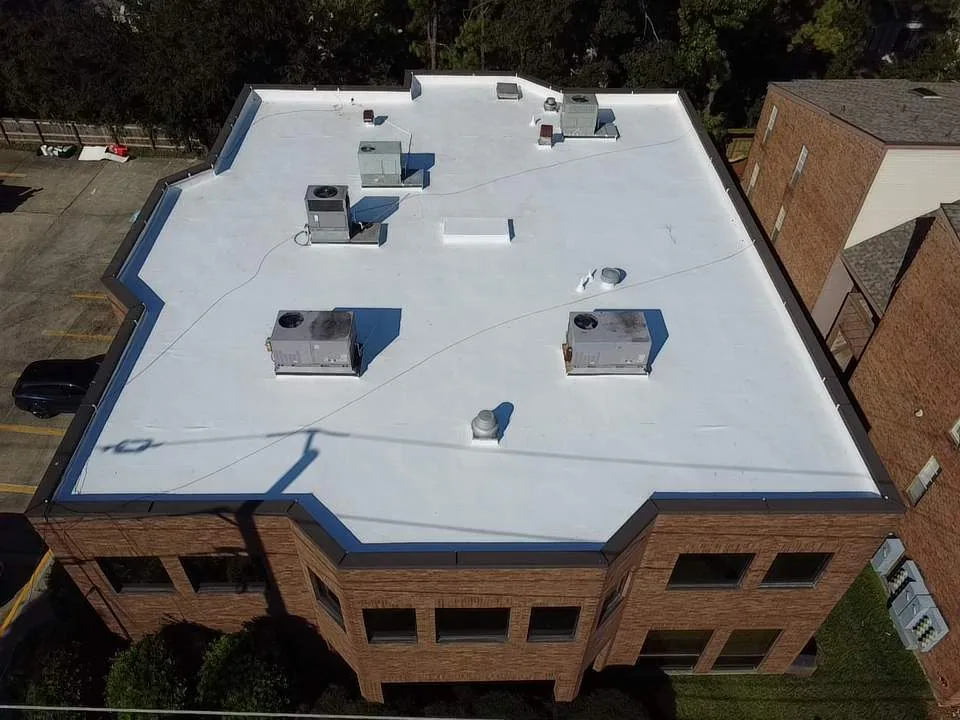
Versico Roofing Systems in Dearborn, MI
A shopping center roof is one membrane over many tenants, and the way that membrane is attached decides how it behaves in wind, how a repair is made and how far a leak can travel. Dearborn's business districts mix shops, restaurants and offices, and Ford Road between M-39 and Mercury Drive shows up in the city's audited report as a redevelopment stretch. Single-ply is one of the systems used on retail roofs, and Versico offers single-ply membranes in the TPO, EPDM and PVC families with roof insulation.
On a Dearborn, MI retail roof of any of these families, the detail that controls a repair is usually the demising wall between tenants, where a parapet, a flashing and a drain may all meet. The written findings start with the attachment method, since it decides what the repair can look like.
Mechanically Attached, Adhered and Ballasted Sheets
A mechanically attached sheet is fastened through plates at set spacing. An adhered sheet is bonded over its area to the substrate. A ballasted sheet is held by stone or pavers. Each has its own signs of distress: plates that back out and ridge the sheet, adhesive that lets go at edges, ballast that has shifted and uncovered a seam.
We identify the method from the surface, a probe of the sheet and, where needed, a core cut. The findings record the method per section. A repair is then matched: a fastener reset, an adhesive reattachment or ballast redistribution. A roof with ballast also gets a check of the structure's capacity before any added weight is proposed, and the findings flag when an engineer's review is needed.
Perimeter and corner zones usually carry closer fastener spacing or added attachment, because wind loads concentrate there. The walk checks that the pattern at those zones is intact, and a gap in the pattern is entered as a repair item with its location marked.
Wind and Hail Inspection After Severe Weather
The September 2026 storms brought wind damage, hail and tornadoes to Southeast Michigan, an EF-0 at Lincoln Park and an EF-2 at Detroit among them, and a retail roof gets walked afterward. The inspection looks for what a storm did to the building, with dated photographs.
The walk starts at edges and corners, where wind lifts metal and membrane, then moves to the field for hail marks, punctures and bruising. Hail damage to a single-ply sheet can be small and hard to see, so we probe soft spots and test for moisture. A wind damage record separates new damage from older wear, which keeps a claim and a repair scope aligned.
Edge metal gets its own pass. Coping that has shifted, fascia that has bent and sealant that has cracked each let wind under the membrane at the perimeter. Each piece is pressed by hand, photographed and entered against the section number, and loose pieces are reset with the fastening the detail calls for.
Drainage, Taper and Ponding
Water arrives in most months here, 35.05 inches in a year, so drainage never leaves the checklist. Tapered insulation under the membrane gives a roof its slope, and a roof with sound taper clears water within a day or two. Water that stays marks a low spot, a settled drain or compressed insulation.
We mark each pond on the plan, record its depth and photograph it from a fixed position. The repair follows the cause: a drain correction, tapered fill or a local deck repair, as set out in the scope for ponding water. A recover over a ponded section is possible only if the insulation is dry, and the findings show the moisture readings that support the choice.
Winter adds a reason to act. The Dearborn record shows a snow season from about mid-November to early April, and a pond that freezes loads the sheet and works seams open. The autumn walk reviews every pond marked in the earlier record and puts those that grew into the repair queue first.
Demising Walls, Curbs and Tenant Equipment
On a multi-tenant roof, each tenant may hold rooftop equipment, and each unit adds a curb and penetrations. Parapets between tenant spaces carry flashing on both sides, and a failed termination can leak into either unit. We number the roof sections to match the tenant spaces beneath, so a leak report is traced to the roof above it.
For a shopping center or a big box store, the plan also records which tenant's contractors access which sections. When a new unit is added, the curb is flashed with a detail made for the membrane family, and the closeout photographs show it before the cover goes on. Walkway pads protect the routes between hatch and units.
Drains near demising walls are checked for settled sumps and loose rings, because a drain that sits high next to a wall holds water against the flashing. The repair resets the ring, replaces the gasket and re-tests the flow.
Retail Districts and Redevelopment Areas
Redevelopment is under way in West Dearborn and the Fairlane and Midtown area, with an assessment at the former Fairlane Town Center property. Owners in the Fairlane and Midtown District or in Dearborn Heights, where the municipal plan ties economic development to commercial corridors on Van Born, Inkster and Joy roads, can use the same inspection format to compare retail roofs across properties.
The comparison covers attachment, seam condition, drainage and details. The result ranks which roof is closest to a repair, which to a recover and which to replacement, with the evidence behind each. A buyer of a redevelopment site can order a roof inspection before purchase, and the findings are written to serve that use.
Roof signs, antennas and satellite equipment can add penetrations to a retail roof. Each is checked for a proper curb or boot, and any that were set with a sealant patch alone are listed as repair items.
Warranty Terms and Comparison
A Versico warranty, where there is one, is read before work begins, and the maintenance visits it calls for are logged beside the installation evidence. Owners comparing a replacement can set the existing assembly beside Carlisle SynTec or GAF alternatives with the same findings in hand.
Commercial Roofing Questions
How can I tell whether my retail roof is mechanically attached?
Look for rows of fastener plates under the sheet and a slight ripple between them. An adhered sheet lies flat. A core cut confirms the method, and the findings should state it for every section.
What should I do after a severe storm passes over a shopping center?
Schedule an inspection of edges, corners and the field, and photograph damage before any repair. Hail marks can be small, so ask for probing and a moisture check. Keep the record with the roof plan for a claim.
Why do leaks in one tenant space start over another?
Water travels along decks and ducts before it drops, so the stain can sit away from the entry. Number roof sections to match the tenant spaces and trace the water path upward.
Is ballast a problem for a structure?
It adds weight, so check the structure's capacity before adding or moving stone. Ask for an engineer's review where records are thin, and restore ballast to its designed pattern after any repair.
How long can a pond sit on a membrane before it needs a repair?
Water that remains after a day or two points to a low spot. Mark it, measure it and have a moisture scan done. Price the correction as an allowance with the test named.
Schedule an inspection and send the tenant roster
Send the roof plan, the list of tenants and equipment, and any past reports. We will document attachment, seams, drains and details in written findings that state which repair, recover or replacement the record supports.