
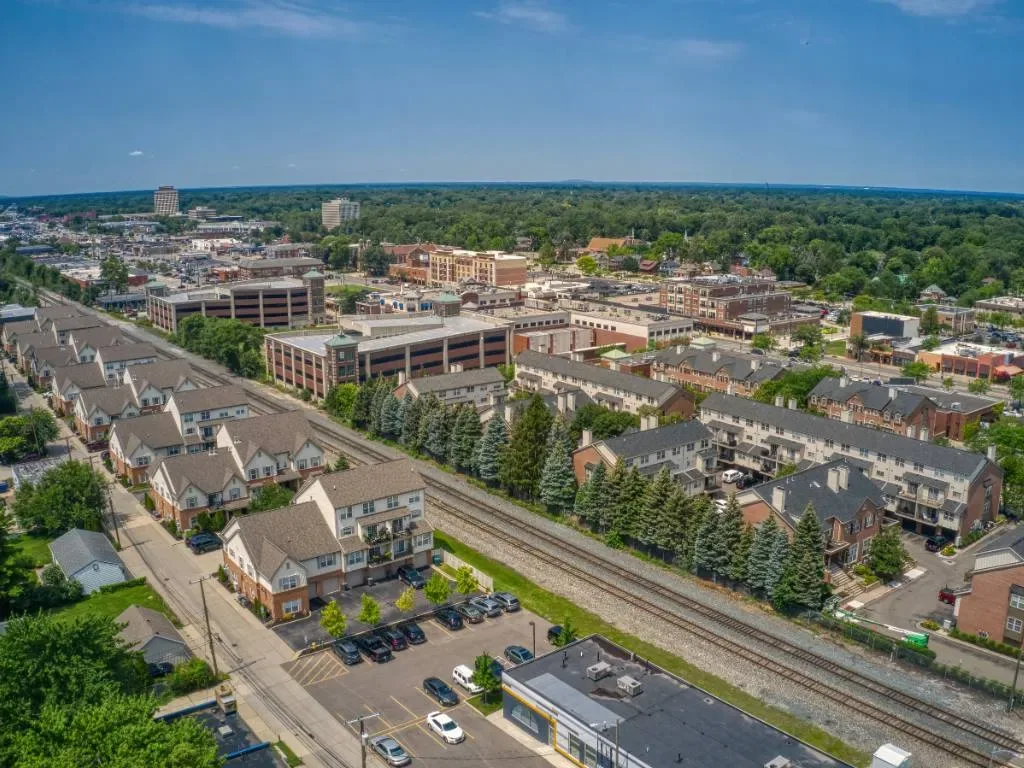
Commercial Roofing in Dearborn Heights, MI
Commercial frontage is the part of a business district that customers see, and the roof behind it is the part that decides whether the shop stays open after a thaw. The municipal master plan for Dearborn Heights, MI ties economic development to its commercial corridors and business frontages, identifies shared commercial corridors on Van Born, Inkster and Joy roads, and calls for business-district investment along Ford Road and Michigan Avenue.
For a property manager or owner on those corridors, the roof question starts with the building's use and the detail that controls water entry. On those corridors the first walk identifies the assembly, rates each roof section and records the condition that changes the decision, whether that is a failed flashing, a blocked drain or wet insulation.
Roofs Behind Commercial Frontage
A building with a street frontage can have a front parapet, a canopy or a sign mount, and each of those is a roof detail. The parapet carries a coping and base flashing, a canopy ties into the wall with its own flashing, and a sign mount passes through the roof or the wall. Water enters at these junctions long before it enters through the field of the membrane.
We walk each frontage detail in sequence, from coping to base flashing to canopy tie-in, and record condition by roof section. Cracked sealant, open coping joints and loose terminations are photographed from a marked position. A repair at the front of a building does not stop at the parapet; the findings follow the water path back to its source.
Canopies and awnings deserve their own entry. The tie-in between a canopy and the wall is a flashing that sheds water from two surfaces, and a failed sealant line there lets water behind the wall finish. We check the canopy drain, the fasteners and the wall flashing, and we photograph the underside where it can be reached.
Shared Corridors and Many Owners
A shared commercial corridor can put many different roofs on a single street. Adjoining buildings may share a wall, a drain line or a parapet, and a leak on one side can start on the other. We ask whether the wall is shared, whether the drain leader is common and who maintains the roof section that touches the wall.
That information goes into the roof plan. If a shared wall carries a flashing that belongs to the adjoining roof, the findings say so, and the repair boundary is drawn at the line of responsibility. The owner has a document that can be shown to the neighbor, which is more useful than a dispute about whose gutter failed.
Drain leaders are traced where they pass between buildings. A leader that runs inside a shared wall can leak into either space, and the water test at the drain, watched from below, shows whether it carries flow or sheds it into the wall.
Business-District Investment and Roof Timing
The plan's call for investment along Ford Road and Michigan Avenue brings storefront improvements, tenant changes and building upgrades into view, and a roof belongs on that list. A facade project or a tenant fit-out is a good moment to inspect the roof, since scaffolding, lifts and permits may already be in place.
The written findings give the owner a remaining service life estimate for each section and a repair queue. If a replacement is likely within a few seasons, the owner can decide whether to bundle it with other work. If a repair will do, the findings show what it covers and what it leaves. For a shopping center or a strip of shops, section numbers match tenant spaces so decisions can be made unit by unit.
Permits and code review enter at this stage. A reroof that replaces a large share of a roof may be reviewed against the current code, and the local enforcing authority sets the process. We list the expected permit step in the scope, so the owner can plan the schedule and the budget around it.
Cold-Season Exposure Measured in Dearborn
Dearborn, next door, sees 30.8 inches of snow in a normal year, nearly all between November and April, plus 35.05 inches of total precipitation, and Dearborn Heights roofs live in the same weather. Measurable snow typically begins around November 16 and ends around April 7.
Over those months snow banks against parapets and equipment, thaw water heads for the drains, and a drain that is half blocked ponds water against flashing. The autumn walk clears outlets and checks coping and terminations. The spring walk records lifted metal, opened seams and ponded areas, photographed from the same positions.
Repair, Recover and Replacement
On a corridor storefront the three paths separate cleanly. A repair suits one failed detail in a sound membrane, a recover suits a worn membrane over dry insulation and a sound deck, and replacement suits wet insulation across a wider area or a damaged deck. A moisture scan and test cuts place the roof on one of them, and the findings state the result for each section.
A large reroof here is permitted under the 2021 Michigan Building Code (effective April 9, 2025), and the 2021 Michigan Commercial Energy Code (effective April 22, 2025) may reach the insulation depending on scope. The city's enforcing office confirms what applies before a figure is fixed.
Items that depend on a test, such as the area of wet insulation or deck repair, are carried as allowances that name the test and the approver, so the figure does not shift without notice.
Working Across Neighboring Cities
Owners with buildings in Dearborn Heights and Dearborn can ask for one findings format for all of them. A property in West Downtown Dearborn, one in the Fairlane and Midtown District and one here are rated on the same scale and photographed in the same way. Owners in Inkster or Garden City can request the same format.
The comparison shows which roof needs money first and which can wait, with the tests behind each decision.
The same format helps when ownership changes. A buyer or a lender can read the roof file and see the condition, the tests and the open questions, without a second inspection of items already documented.
Commercial Roofing Questions
What should I check first on a storefront roof after a thaw?
Walk the parapet, the coping and the base flashing, then the drains. Photograph any open joint or loose termination from a marked position. Ask for a written finding that names the entry point.
How do I deal with a leak that starts at a shared wall?
Document the location with photographs, identify whose roof section touches the wall and share the findings with the neighbor. Ask for the repair boundary to be drawn at the line of responsibility.
When is a facade project a good time to check the roof?
When scaffolding, lifts and permits are in place. Ask for an inspection before the facade crew leaves, and coordinate flashing heights with the finished wall.
Do Dearborn's snow numbers apply to my Dearborn Heights roof?
Dearborn is next door and shares the regional weather, so its snow season is a fair guide to when to look. A particular building's snow load is an engineer's question, and its condition comes from an inspection.
What does a written finding add to a repair quote?
It names the roof section, the entry point, the test and the remaining service life, so the quote can be compared with the condition. Keep it with the roof plan.
Schedule an inspection or emergency response
Tell us what the building is used for, where water is showing and how the roof is reached. We will document the roof section, the water path and the condition, then state which repair, recover or replacement the written findings support.
