
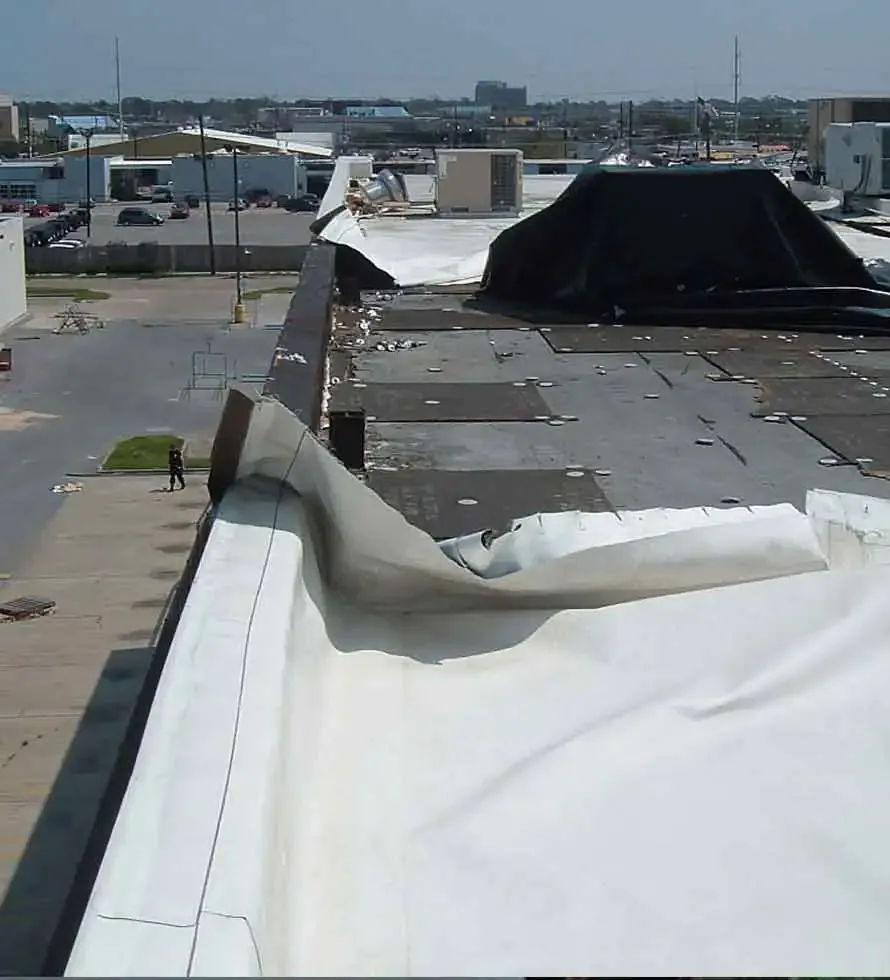
Wind Damage Roof Repair in Dearborn, MI
A big-box store, a warehouse, and a strip of storefronts on Warren Avenue can all lose roof material in the same wind, and the damage will not look the same on any of them. The big roof loses a corner of membrane, the warehouse loses a run of coping, and the storefronts lose a few flashing strips at the parapet. Wind damage repair in Dearborn, MI therefore begins at the perimeter and works inward, and it ends with written findings that name the detail that controlled each failure.
The first check is simple, and it costs nothing but time on the roof: walk the edge, touch each cap and cleat, and record which ones move under a hand. Before anyone repairs a tear, we find where the wind entered, because a lifted edge will lift again if the metal or the attachment beneath it was the weak point.
Perimeter Metal and Edge Terminations
Edges come first because the air that crosses a roof speeds up and drops in pressure at its borders, which pulls hardest on the outer feet of the membrane field. We walk the entire edge in sequence: coping caps, fascia, drip edge, gutters, and the termination bar where the membrane turns up a wall. Look for caps that have shifted, joints that have opened, fasteners that have backed out, and sealant that has pulled away from its metal.
A cap that has moved even a little has already broken its seal. We photograph each loose piece with a marker for location, then record whether the metal itself is bent, whether the cleat beneath it holds, and whether the substrate takes a fastener. Repair means resetting or replacing the metal, adding fasteners into sound substrate, and resealing the joints. Our work on edge metal, coping, and gutters follows that order.
Lifted, Billowed, and Torn Membrane
On a mechanically attached roof, wind can pull fasteners through the sheet or work them loose from the deck, and the sheet will show lines of stress and rows of plates standing proud of the surface. On an adhered roof, wind can break the bond and lift a blister of membrane, usually near an edge or a curb. On a ballasted roof, it can scatter stone and leave the membrane bare. Each failure leaves its own mark, and the mark tells us how far to open the repair boundary.
A torn sheet is cut back to sound material and patched with a piece that extends past the damage on every side, using the method that suits the membrane. A heat-welded TPO membrane takes a welded patch, a rubber sheet takes a bonded one, and we confirm which is on the roof before opening anything. The seams near the damage are probed afterward, since a gust that lifts one section can open a lap that looks closed.
Water Path After the Opening
Once the membrane opens, rain and snowmelt travel under it and into the insulation. The weather station record for Dearborn averages 35.05 inches of precipitation a year, spread over many days, so an opening left unrepaired does not wait long for weather. We map the likely water path from the opening, scan for moisture, and take a core where the scan shows a wet pattern. Wet insulation changes the scope: the repair then includes removal and replacement of the board, not just a patch on top.
Temporary protection goes on first. A tarp, a temporary membrane patch, or a sealed edge is photographed in place, with a follow-up date on the record. A crew can reach a building at any hour of the day or night for emergency roof repair when an opening needs covering.
Storm Records and the Buildings They Touched
Weather service surveys from September 2026 cover wind damage, big hail, and tornadoes in the Southeast Michigan region, with a rating of EF-0 for the Lincoln Park tornado and EF-2 for the one in Detroit. Each finding belongs to its own place. A roof in Dearborn is judged by what its own surface shows, and a post-storm inspection on any building in the region looks for the same signs: displaced metal, lifted edges, torn membrane, and debris impact. The weather record tells us when to inspect, and the roof tells us what happened.
For owners near Lincoln Park and Detroit, the record also helps with insurers, who expect dated photographs of the roof before and after a reported event.
Building Types and Where They Fail First
Large low-slope roofs on warehouses, plants, and retail centers fail first at corners and perimeters. Roofs with many curbs and screens, such as office buildings and medical offices, fail first at equipment bases where a screen or a unit catches wind. Older storefront buildings, like the historic ones in the East and West downtown districts, are worth checking for short parapets and shallow coping, which leave little protection for the roof edge.
A shopping center roof tends to carry signage and rooftop units on a shared deck, and each is a point where wind can work a fastener loose. We check each base, each sign mount, and each screen, because a unit that shifted in wind can cut the membrane beneath it.
Code, Permits, and Prevention
The 2021 Michigan Building Code has been the state's current code since April 9, 2025, and the city or township office that enforces it settles which provisions reach a given repair. A small patch may not need a permit; a large replacement of edge metal or membrane may. Confirm the local requirement before the work is priced, and keep the permit date on the schedule.
After the repair, the question is prevention. We check whether the edge metal gauge and attachment suit the building, whether the termination is mechanically captured, and whether the attachment pattern near corners matches the rest of the roof. Items that are repair are separated from items that are upgrades in the written findings, and the owner chooses which to approve. A related seam failure found during the repair is added to the same scope, and a failed flashing at a curb transition is handled in the same visit.
Commercial Roofing Questions
Where on the roof should a wind inspection begin?
At the perimeter and the corners, then inward along the membrane field. Edge metal and terminations are inspected and photographed in sequence before anything is moved, since the perimeter shows where the wind entered.
Can a lifted membrane be re-secured instead of replaced?
If the sheet is intact, the deck is sound, and the insulation is dry, re-adhering or re-fastening can be enough. A moisture scan and a probe of the substrate decide, and the written findings state the repair boundary.
How do you know whether water got into the insulation?
By scanning for moisture and taking a core where the scan shows a pattern. A dry core supports a patch; a wet core adds board replacement to the scope.
Do regional storm reports tell us what happened on my roof?
They tell us when to inspect. The roof shows the damage, and we record it by section with dated photographs, whether or not a storm report names the town.
What if a rooftop unit shifted in the wind?
We check the curb transition, the flashing, and the membrane under the unit, and the unit's own attachment to the curb. A shifted unit can cut the sheet, so the base is part of the repair.
Will a repair prevent the same damage next time?
It reduces the chance when weak attachment or thin edge metal is corrected. The findings separate repair from upgrade items so the owner decides what to fund.
Send the storm date and the first photographs
Send the date of the event, the building address, and photographs of loose metal or torn membrane, along with the access window for the roof. We will document the condition in written findings, protect the opening, and state the repair boundary that the findings support.