
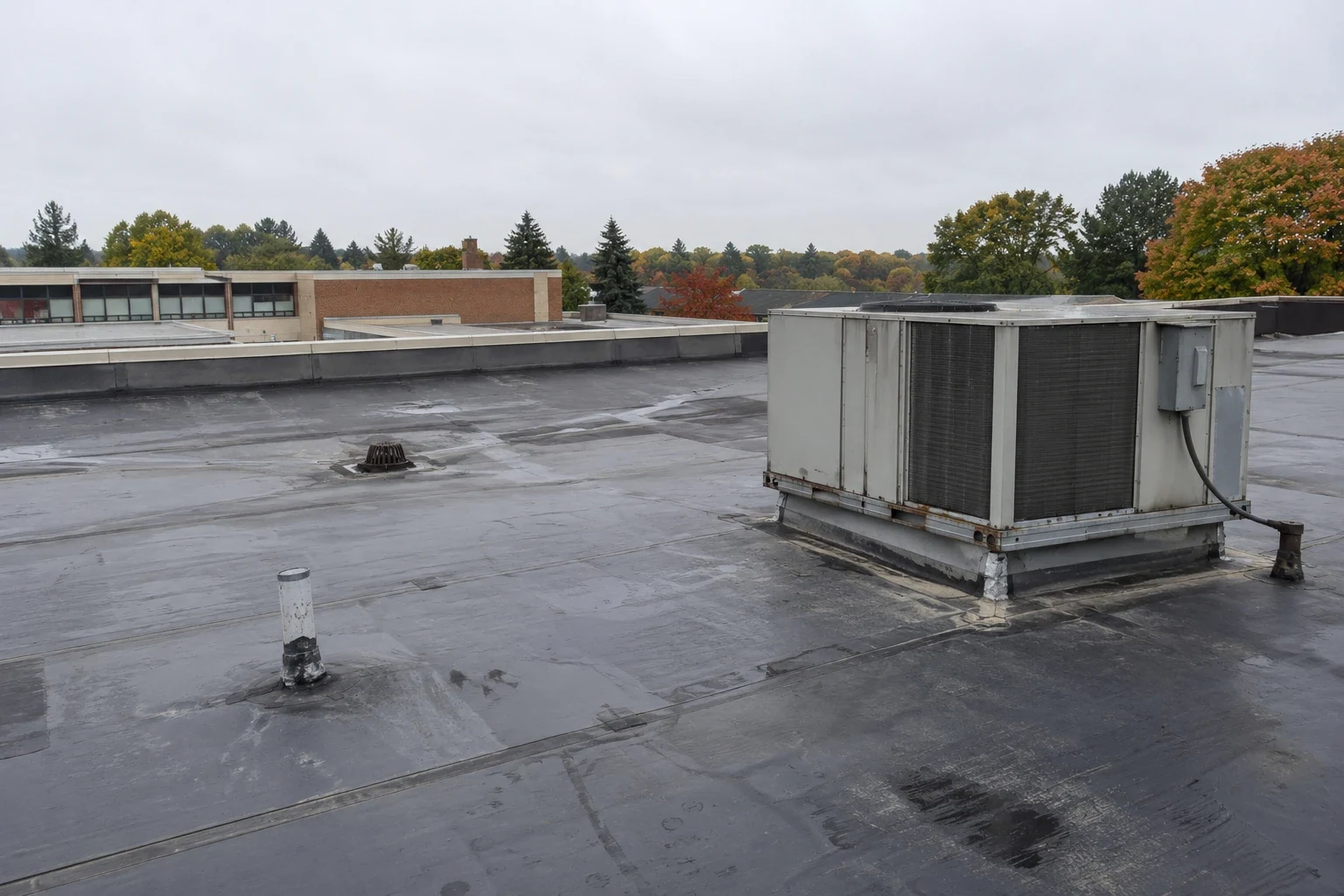
School Roofing in Dearborn, MI
A school building is several roofs wearing one name: a gym with a long span and a high wall, classroom wings with low-slope sections and rooftop units, a kitchen with exhaust, and a connector that was added decades after the main block. In Dearborn, MI each of those sections has its own age and its own weak point, so the first job is to separate them and write down what each one is made.
That separation drives every later choice. A section with dry insulation and a few failed seams can be repaired between terms. A section with wet insulation under a membrane that still looks sound needs a replacement plan, and the plan has to fit the school calendar. A facility director who sees the sections on one drawing can rank them by condition and by what sits below them.
Wings, Gyms and Connectors
Start with the gym. Its walls are tall, its roof spans a wide space, and its parapet catches wind and shed snow. Flashing at the base of those walls takes more movement than flashing on a low parapet, so we check the termination bars, sealant joints and counterflashing first. Next come the classroom wings, where rooftop units sit on curbs and drains collect water from large areas. A connector between buildings is the third check, because it often joins two roof assemblies of different ages at a transition that moves.
Each section gets a number on the plan, a photograph from a fixed position and a note of the membrane type. When the board asks which roof to fund first, the numbers answer with condition, not opinion.
A school gym that doubles as a community recreation space behaves like a fitness center roof, with tall volumes, humid air from locker rooms and rooftop exhaust that releases moisture near the membrane. We check the underside of the deck for condensation as well as the roof surface for leaks, because the two look alike on a gym ceiling and need different repairs. A stain that follows cold nights points inside; a stain that follows rain points outside.
Planning Around the School Calendar
School roofing is scheduled by the calendar before it is scheduled by the weather. In the NWS Detroit record the first measurable snow typically falls near November 16 and the last near April 7, which leaves the summer break and parts of the shoulder months for permanent work. Large replacements belong in that stretch. Repairs that cannot wait for it are done as temporary work, labeled as such, with a return date.
During the school year the work zone is fenced, the lift is parked away from bus lanes and student routes, and noisy steps move to hours the principal names. We confirm the plan with the facility director in writing and list the access window for each section, so the crew does not arrive on a testing day.
Material lead time belongs in the calendar too. Membrane, insulation and edge metal ordered in March arrive before summer; the same order placed in June may not. We list the order date, the delivery date and the weather hold that could move either, so the facility director can ask the board for approval early enough to keep the summer window.
Snow, Ponding and Drain Bowls
Dearborn collects 30.8 inches of snow a year, mostly between November and April, with January alone averaging about 14 inches. On a school roof the practical question is where the melt goes. Snow settles against the gym wall and around rooftop units, then thaws toward a drain bowl. If the bowl is partly blocked, water ponds, and ponding exposes seams and flashing that would otherwise stay dry.
We clear and photograph each drain before the first snow and look again after the first thaw. Ponding that persists after a dry spell points to a deck that has deflected or a drain set too high, and the ponding water repair options range from clearing an outlet to adding tapered insulation. Any structural question about snow load goes to an engineer, since the code sets the figure site by site.
Finding Wet Insulation
A ceiling stain in a classroom is the last place water shows, not the first. Water enters at a seam or flashing, runs along the deck and drops where there is a gap. An infrared moisture survey maps the wet insulation as a pattern, and cores or probes confirm it. The map sets the repair boundary: everything inside it is replaced, everything outside it is kept.
That boundary is what the board needs for budgeting. A school with a small wet area may fund a repair this summer, while one with wet insulation across a wing may need a phased replacement over two summers. We present both, with remaining service life for each section, and the written findings stay with the building file.
Repair, Recover and Replacement
Three paths exist for a failing school roof. Repair restores the failed details and suits a roof with sound insulation. A recover adds a new membrane over a dry existing roof and avoids tear-off, though it adds weight and must meet the energy code. Replacement removes the old assembly and suits a roof with wet insulation or widespread failure.
State rules for this work are the building code adopted in 2021 and in force since April 9, 2025, and a 2021 commercial energy code, in force since April 22, 2025; the energy provisions can change insulation thickness on a replacement. The local enforcing authority is asked about those provisions before the scope is final. Each option is priced and the update names the code questions that remain open.
Where School Roofs Sit Among Dearborn's Institutions
Dearborn is also home to the University of Michigan campus and Henry Ford College, and a college building has a different roof mix, with labs, libraries and fieldhouses. A K-12 school near West Downtown or along Warren Avenue shares weather and drainage conditions with its neighbors but keeps its own roof history. A district with several buildings can place them on one schedule as a multi-site roof program.
Commercial Roofing Questions
How should a district decide which school roof to replace first?
Rank sections by remaining service life and by what sits below them. A gym with wet insulation and a classroom wing with isolated seam failures are different problems, and the survey shows which one carries more risk. Fund the section with the shortest remaining life first, then schedule the rest on the same drawing.
Can a school roof be replaced during the school year?
It can, but summer is better. During term, the work zone is fenced, noise is limited to hours the principal names and the lift stays clear of bus lanes. Large tear-offs belong in the break, and urgent repairs during term are labeled temporary.
What does ponding on a school roof tell us?
It points to drainage or deflection. After a dry spell, standing water at a low point suggests a drain set high or a deck that has sagged. We measure depth, trace the cause and recommend either clearing the outlet or adding tapered insulation.
Does a recover work on a school roof with a small leak?
Only if the insulation is dry. A recover over wet board seals the water in, so the moisture survey comes first. If the board is dry, a recover saves tear-off cost but adds weight, which the structure and the energy code must allow.
Which records should the facility director keep?
Keep the numbered roof plan, dated photographs, the moisture map, any core results and the warranty paperwork. Written findings in one folder let the next director rank work without rediscovering the building.
Schedule a school roof inspection
Tell us which wings leak, when the building is empty and where the roof is reached. We will inspect each section, document the condition with photographs and written findings, and give the board the repair and replacement paths it needs to plan.
