
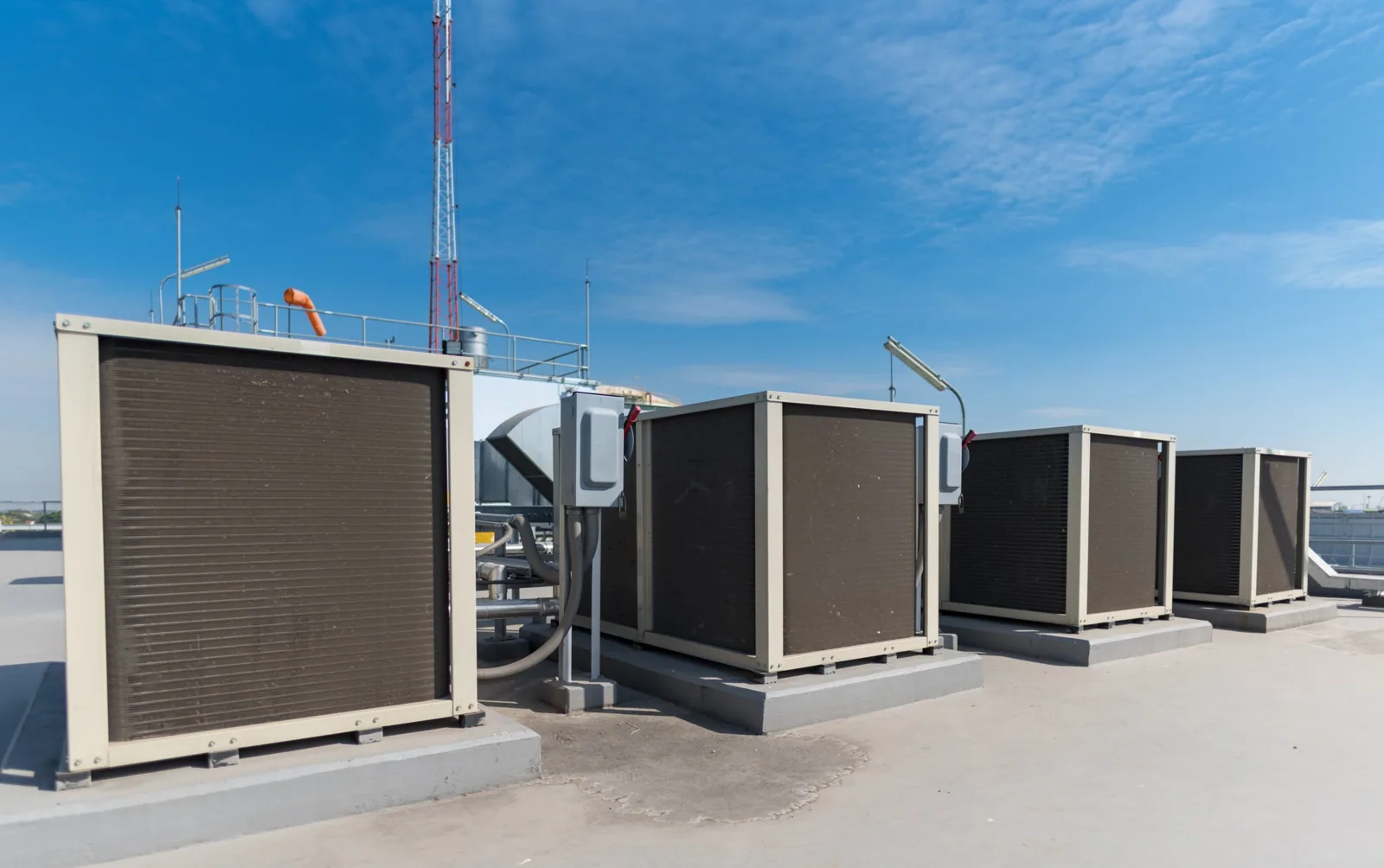
Rooftop Equipment Curbs and Supports in Dearborn, MI
A building with five rooftop units has five curbs, and in a Dearborn winter each curb is a small dam that snow drifts against and meltwater tries to get under. Offices, clinics and laboratory buildings in Dearborn, MI, carry air handlers, exhaust fans, condensers and piping across the membrane, and the roof stays watertight only as long as every transition between equipment and membrane stays tight. Most roof leaks that start near equipment begin in one detail, such as a cracked corner, a pulled counterflashing or a pipe support that rubbed through the sheet.
We check each curb and support in sequence, because the detail that controls the leak is rarely the one that shows the stain.
Curb Anatomy and the Transition That Fails
A curb is a short box, usually wood or metal, fastened to the deck, with insulation inside, a cap on top and flashing carried from the roof membrane up its sides. Water has two ways to beat it: around the base, where membrane meets the curb wall, and over the top, where a loose counterflashing or open cap seam lets water run down the face. Corners are the first trouble spot, since the membrane has to fold or be cut and patched there. A corner that was patched by a different trade than the one who laid the roof is the first place we press.
On the roof walk we look at the flashing height above the membrane, the fasteners along the top termination, the condition of any sealant and the corners. We press on the flashing to see whether it has lost adhesion, and we check whether the curb itself has moved or rotted. A curb that has shifted a quarter inch can open a seam that looked sound last year.
Equipment Supports and Pipe Supports Over the Membrane
Not every unit sits on a curb. Many are set on rails, sleepers or pipe stands that rest on the membrane, and the weight of equipment and the movement of thermal expansion work the surface beneath. A pipe that rolls on a bare support can wear through the sheet in a few seasons. A rail sitting on a thin membrane can create a low spot that holds water.
We check whether supports have protection pads, whether they have shifted and whether the membrane beneath shows scuffing, splitting or ponding. Where a support is worn through, the repair replaces the damaged membrane and adds a pad or a raised stand so that weight spreads and water can pass beneath. Penetrations for conduit or gas lines are checked at the same visit, because a boot that has hardened in cold weather is a common entry point.
Snow, Drifts and Freeze-Thaw at Equipment
Dearborn's station records an annual snowfall near 30.8 inches, nearly all of it falling from November into April, and it counts more than 4,000 heating degree days. A rooftop unit interrupts the wind, so snow drifts on its windward and leeward sides and sits against the curb. Meltwater from that drift runs along the curb wall and, if flashing is tired, finds a way in. Refreeze at night then widens any gap.
After a thaw we look for ice at the base of the curb, staining on the membrane and any place where water has pooled beside the equipment. Heated units shed melt faster than the rest of the roof, which can cause icing at drains and scuppers downslope. We note these patterns in the written findings and recommend drainage or flashing changes that match.
Laboratories, Campuses and Process Buildings
Higher-education and research buildings often carry a heavy equipment load. The campus map for the University of Michigan in Dearborn lists engineering, science, research and library buildings, and Henry Ford College has its own campus facilities, so equipment-heavy roofs can be expected on those campuses. The same is true of buildings tied to Dearborn's manufacturing and research employers, including the Ford complex the city describes as under reconstruction.
On these roofs, a unit replaced during a mechanical upgrade often arrives with a new curb that does not match the old flashing. We record who installed each curb, when, and whether the roofing was reconnected to the work. That history tells the facility director which curbs are likely to leak and which are original and sound. Our college and university roof work and manufacturing plant roof work both start with that inventory.
Repair, Rebuild or Relocate
A cracked sealant line or a loose counterflashing calls for targeted repair. A curb with rotted framing, or flashing that cannot be reattached to sound material, calls for a rebuild: the old flashing is cut back, the curb is repaired or replaced and new flashing is installed and tied into the field. Where equipment is being replaced anyway, the best time to rebuild a curb is during that work, with the roofer on site.
If equipment can be raised on stands or relocated, the membrane beneath it can be replaced in a controlled area rather than around a running unit. A repair with a defined boundary and a flashing rebuild at a penetration often settle the question. Written findings rank each repaired detail by how soon it needs another look, so a facility director can see which curbs buy a season and which buy several, and can budget accordingly. When many curbs are failing at once, the roof is telling the owner something about the age of the assembly, and a replacement may be the sounder spend.
Work Area and Coordination With Mechanical Trades
Curb work often requires the mechanical contractor. A unit may need to be shut down, disconnected or lifted, and the order of work has to be agreed before anyone arrives. We write the sequence: who shuts the unit, who lifts it, when the roofer rebuilds the curb and when the unit is set again. The access window and the work area are marked on a roof plan, with the route for material.
For facilities in the Fairlane and Midtown area, along Warren Avenue or in West Downtown, the same plan format applies, with photographs of each curb before and after.
Commercial Roofing Questions
Should a failing curb be repaired or rebuilt?
Repair if the curb framing is sound and the failure is limited to sealant or a loose termination. Rebuild if the framing is rotted, the flashing cannot be reattached to sound material, or the curb has moved. We show both costs on the findings sheet.
Why do leaks around rooftop units appear after a thaw?
Snow drifts against the curb and melts into the corner or the base seam. If the flashing has lost adhesion or the counterflashing is loose, that water finds the gap. The leak is usually timed to the thaw, not the storm.
When is the best time to rebuild a curb?
When the unit is being replaced or lifted for service. The roofer can then rebuild the flashing around an empty curb, which is faster and more reliable than patching around a running unit.
Do pipe supports damage the membrane?
They can. A bare support under a rolling or expanding pipe wears through the sheet over time. Pads, raised stands and rails that spread load prevent it, and we check for wear at each visit.
How do you coordinate with the mechanical contractor?
We write a sequence listing who shuts down, lifts and resets each unit, when roofing work occurs between those steps and where material moves. The access window is agreed with the facility director before work starts.
Schedule a rooftop equipment inspection
We will inspect each curb and support in sequence, document the condition with photographs and written findings, and give you the repair or rebuild options that record supports.