
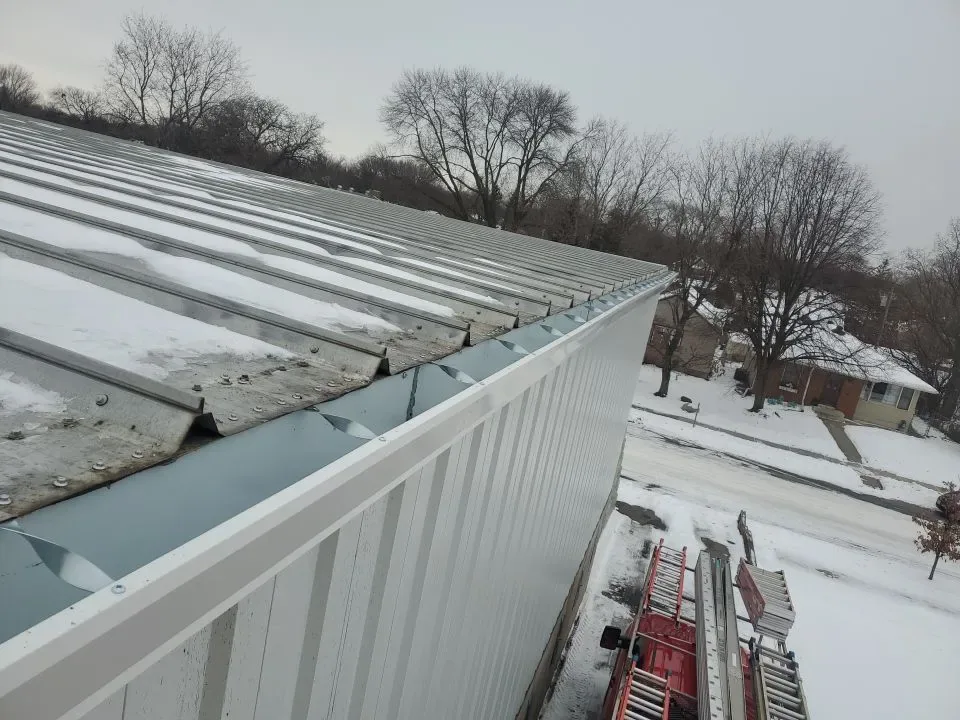
Commercial Roof Edge Metal, Coping and Gutters in Dearborn, MI
A roof perimeter has to hold the membrane or panel edge while directing water away from the wall. Coping, fascia, gutters, and downspouts each handle a different part of that job. Loose metal, open laps, failed sealant, or a blocked outlet can expose the roof edge and building envelope. We inspect the connected details together, then define whether the repair is limited to one component or needs a longer run to reach stable attachment.
Dearborn's climate includes an average 30.8 inches of annual snowfall at the local weather station, and the September 2026 storms across Southeast Michigan brought damaging wind as well. Snow and gusts can loosen an edge, and only a look at the metal confirms it. A commercial roof inspection can document perimeter details alongside the field and penetrations.
Inspect the Edge as a Connected Assembly
We trace the roof termination from the membrane or panel across the edge, over the fascia or parapet, and into the wall-side detail. We check cleats, fasteners, splice plates, corners, sealant joints, and substrate. If a coping cap has shifted, we check whether its attachment remains secure and whether adjoining sections have separated. A superficial sealant bead cannot substitute for missing cleats or a sound mechanical connection.
Gutters and downspouts require a separate water-path check. We look for sagging, seams that have opened, standing debris, damaged hangers, disconnected leaders, and discharge that returns toward the foundation. The roof's runoff should reach the intended outlet without spilling behind the fascia. When water backs up at a transition, the cause may lie in the gutter, the roof slope, or a blocked downspout. A drainage assessment can evaluate related roof outlets and overflow paths.
Metal can move as temperatures change. Long runs need joints and attachment methods suited to that movement, and repairs must account for corrosion or incompatible materials at existing interfaces. We identify the metal type and condition before proposing a patch or replacement. If roofing work is planned nearby, the replacement service can coordinate perimeter details within a larger assembly scope.
Repair Attachment before Sealing the Joint
A sound edge repair begins with stable metal and substrate. We remove loose material, replace failed fasteners or cleats where appropriate, and rebuild the transition so the membrane remains secured. At a parapet, the coping cap, joints, corners, and wall-side condition need compatible coordination. At a gutter edge, the membrane or metal roof must terminate in a way that does not rely on an exposed bead of sealant as the primary restraint.
When damage extends across a long section, a short patch may leave weakened attachment at both ends. We map the affected length and compare localized repair with replacement of a continuous run. The scope identifies the stopping points and how new metal will connect to existing sections. A standing-seam roof review is useful when panel seams, trim, and roof edge components need to be considered as one metal assembly.
Gutter replacement also requires matching capacity and outlet locations to the existing system. We document the gutter profile, hanger spacing, leader connections, and conditions at corners. If water is overflowing during moderate rain, simply enlarging the gutter may not solve an undersized outlet or blocked leader. The adjoining scupper and drain path can affect that decision, so it gets checked in the same visit.
Follow Water beyond the Metal Line
Perimeter leaks can enter behind a coping cap, travel along a wall, and appear inside well away from the roof edge. We inspect the roof-side termination and look for evidence at the wall, ceiling, or structural edge. A leak at a gutter may also involve overflow behind the fascia or a downspout joint that releases water into the wall assembly. The report should separate observed wet areas from likely paths that still need confirmation.
At the Dearborn station, measurable precipitation occurs on roughly nine to twelve days in most months. Repeated runoff tests edge seams, corners, gutter joints, and outlets over time. We check for debris and ponding, but also identify whether water has a clear path away from the building. In winter, ice can hide a failed outlet or place additional load on a loose gutter. Seasonal service should record what could be reached safely and what needs a warmer-weather review.
Corrosion deserves attention where dissimilar metals meet or where water remains trapped in a seam. Adding a coating or sealant over corrosion may hide thinning without restoring the connection. A roof repair visit can address adjacent membrane or flashing conditions when the edge is not the only failure.
Coordinate Perimeter Work with Building Access
Edge work often takes place above entrances, loading bays, sidewalks, and employee routes. Lifts and barricades may be needed to reach gutters or downspouts safely, and debris control is important above occupied space. We identify the work zone and delivery path with the facility contact, then plan a sequence that keeps a safe route open where feasible. On a warehouse roof, loading and truck movement may affect where equipment can be staged.
Warren Avenue extends across East Dearborn from Greenfield Road to Wyoming Avenue, with food businesses, pharmacies, and medical offices among its uses. On an occupied storefront, sidewalk access can affect lift placement and temporary closures. The city reports facade improvements and planned roadway reconstruction, so the site contact should confirm active work before crews arrive.
West Downtown follows Michigan Avenue and includes historic architecture, retailers, restaurants, and coffee shops. Older facades may have distinct wall and parapet interfaces that need careful inspection, so on a West Downtown building we record the actual coping, substrate, and roof termination before choosing a repair.
Record the Run and the Repair Boundary
After repair, the owner should know which edge runs were opened, which components were replaced, and which adjacent areas remain in service. We provide photographs of corners, joints, attachment points, and discharge details, with a note of any inaccessible segments. If gutters were cleaned, record that separately from metal repairs so future maintenance does not confuse the two tasks.
A recurring perimeter route can catch loose fasteners, separated laps, debris, corrosion, and blocked leaders before water reaches the building. The team can log dates and locations, then compare photographs. Recheck the edge after nearby facade or rooftop work. A roof asset record can store the detail history with other roof maintenance data.
For a building along Dix-Vernor or Warren Avenue, crew access and storefront operations may vary from one visit to the next. We retain the repair boundary and staging notes so a future team can plan access from the record. Clear records help the owner decide whether the next step is cleaning, localized repair, or a longer replacement run.
Commercial Roofing Questions
Can loose coping be fixed with sealant?
Sealant can protect a properly attached joint, but it cannot replace missing or failed mechanical attachment. We check cleats, fasteners, substrate, and adjacent sections before choosing a repair. If the cap can move, attachment should be addressed before sealing the joint.
Why does water run behind a gutter?
Possible causes include a blocked downspout, sagging gutter, open seam, poor slope, or an edge termination that directs runoff incorrectly. We inspect the connected route from roof to discharge and identify the component that needs correction.
Should a gutter be replaced along its entire length?
We map the damaged length and check whether a short repair can tie into stable material. The scope identifies its endpoints so the owner can compare a localized fix with continuous replacement.
Do metal roof edges need inspection after high winds?
A post-weather check can identify shifted caps, loose fascia, open joints, and related membrane movement. Access must be safe, and the inspection should include corners and transitions where attachment changes. We document findings without assuming damage from regional weather reports.
What maintenance interval fits a commercial gutter system?
Set the interval from debris exposure, roof use, and the building maintenance plan. Record service dates, verify outlets are clear, and investigate recurring overflow instead of repeating cleanings without checking the cause.
Inspect the Perimeter and Drainage Path
Arrange a Dearborn roof-edge assessment. We will review coping, fascia, gutters, downspouts, and transitions, then document practical repair limits.