
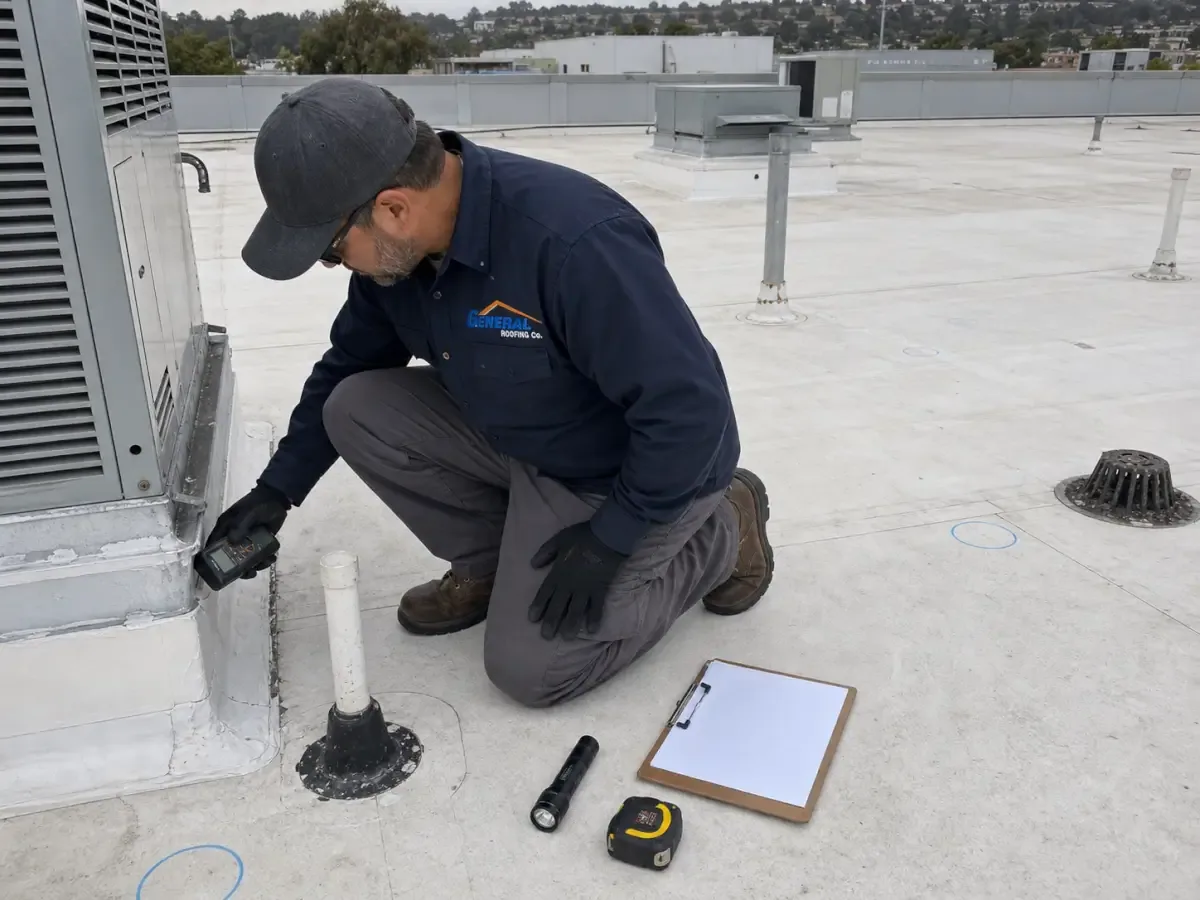
Roof Asset Management in Dearborn, MI
A portfolio that mixes a campus lab, a corridor retail strip, and a plant has three different roofing problems, and tracking them on one spreadsheet column called condition hides all three. For owners in Dearborn, MI, asset management begins with what the building is used for and how the roof is put together, and it flags the condition that will change the next decision: a wet insulation finding that moves a section from repair to replacement, a drain bowl that keeps clogging, a curb transition that has been patched twice. The record exists so that decision can be made once, with evidence, instead of every time a tenant calls.
Each roof section gets its own entry. The entry carries the assembly, the findings, the next action, and the date by which that action stops being optional.
The Section Record
A building is rarely one roof. A fieldhouse may have a high main span, a low mechanical roof, and a canopy; a retail strip may have the original roof and a later addition with a different membrane. We divide every building into numbered sections, photograph each from fixed positions, and log the assembly, the layers found, the attachment, the drain count, the flashing and edge condition, and any known repairs. The same photographs retaken a year later are the best evidence of change.
The record also holds gaps. A section whose insulation has not been tested is listed as untested, with the scan or core that would settle it, so nobody confuses a surface rating with a moisture finding. When a test cut shows a wet core, the entry changes from monitor to replacement planning, and the repair boundary is drawn on the plan.
Condition, Remaining Service Life, and Consequence
Each section receives a condition rating built from the surface, seams, flashings, drains, and moisture, and a remaining service life estimate that states its basis. A rating means little without a consequence, so the entry also says what happens if nothing is done this year: a leak into a corridor, a widening of the wet area, a lost warranty position, or nothing urgent. A section with a sound sheet and minor flashing wear stays on the maintenance schedule. A section with open laps and ponding sits in a repair-or-recover window. A section with confirmed wet insulation and repeated patching belongs in replacement planning.
The ratings feed the capital plan and rest on the evidence in a written condition report. Owners who see both can trace any figure back to a photograph.
Mixed Portfolios in the Dearborn Market
Four districts carry the city's own business designation: East Downtown, West Downtown, Warren Avenue, and Dix-Vernor, where shops, restaurants, and professional offices cluster. Annual reporting by the city points to office and mixed-use building activity in West Dearborn and around Fairlane, and the University of Michigan-Dearborn campus map runs from engineering and science halls to a library, a fieldhouse, and a parking structure. Henry Ford College adds an athletic building and other campus facilities.
A portfolio that spans those settings has to treat them differently. A storefront in the East Downtown district has a small roof and limited access. A campus building has several roof levels and a facility staff that wants written findings. A retail strip on Warren Avenue can carry units and signs added by tenants over time. The record notes the operating constraints beside each section so the plan sequences work by setting.
Who Owns Which Roof
Ownership shapes the record as much as the roof does. A building owner who leases to several tenants carries the membrane, while a tenant may carry a rooftop unit. A condominium of storefronts may split the roof by unit line. A campus owner carries everything, but different departments call in different leaks. Before ratings mean anything, the record has to say who pays, who approves, and who is called, because a repair stalls when nobody is sure whose roof it is.
We list for each section the owner of the membrane, the owner of any equipment on it, the tenant or department below, and the lease or policy clause that governs repairs. When a leak call arrives, the contact sheet tells the crew who to phone and the findings tell the owner which section and which party are involved. The same sheet makes it simple to see which roofs are the owner's responsibility this year and which belong to a tenant.
Warranty and insurance status ride beside it. A section under warranty has notice dates and repair rules that a section outside warranty does not, and a roof with a lapsed policy or an open claim needs its photographs preserved. The entry says which applies, so a facilities manager does not have to dig through folders on the day a leak is found.
Inspection Cycle and Maintenance Entries
A record that is not updated becomes a historical file. Each preventive maintenance visit adds a dated entry: drains cleared, laps probed, flashings checked, new penetrations logged, photographs retaken. Small repairs are tied to the section number, so the plan shows how much has been spent on one section. When patching approaches a stated share of what a recover would cost, the entry flags it, and the owner can choose with the numbers in front of them.
Because snow lies on Dearborn roofs for much of the period from mid-November to early April, the cycle places the heaviest checks before and after that window: drains and edges in the fall, a full walk after the thaw. A hands-on inspection each year updates the ratings, and a walk after any severe storm adds a dated entry.
The Decision the Record Supports
The output is a ranked list that a finance reader and a facilities reader interpret the same way: repair now, recover, replacement planning, or monitor, each with a cost range and a window. The same data supports a multi-site program when buildings are spread across several cities, gives claims staff the dated photographs they need after a storm, and shows a lender or buyer the roof's history in a due diligence survey format.
Property managers who report to owners can use it for their own reviews, and so can the property management companies that run many buildings.
Commercial Roofing Questions
How much of a portfolio should be walked before the record is useful?
Walk every roof section that carries interior risk or a deferred repair, and sample the rest by age and type. Sections not yet walked are listed as unknown, with a date to close the gap, so the first ranking is honest about what it covers.
Is a visual rating enough to schedule a replacement?
Not alone. A visual rating justifies a moisture scan or test cut, and the result justifies the schedule. A confirmed wet core is the finding that moves a section from repair to replacement planning.
What fields matter beyond condition?
Assembly, layer count, attachment, warranty status, repair history, drain count, access, and tenant hours. Those fields let the plan price work by section and sequence it around the building's use.
How often should entries be updated?
After each maintenance visit and inspection, and after any storm that reaches the building. Updates are made by section with photographs from the same positions.
Can the record help with an insurance claim?
Yes. Dated photographs and condition entries show the roof before an event, which helps separate storm damage from earlier wear. The insurer decides coverage; the record supplies the roof facts.
Does asset management replace a capital plan?
It feeds it. The record states condition and consequence by section, and the capital plan converts them into a multi-year schedule with permit dates and funding windows.
Send the building list, roof records, and access windows
Send the addresses, any drawings or earlier reports, the access window for each roof, and the capital cycle you are working to. We will schedule an inspection, return written findings by roof section, and state which entries rest on measured evidence and which remain open.