
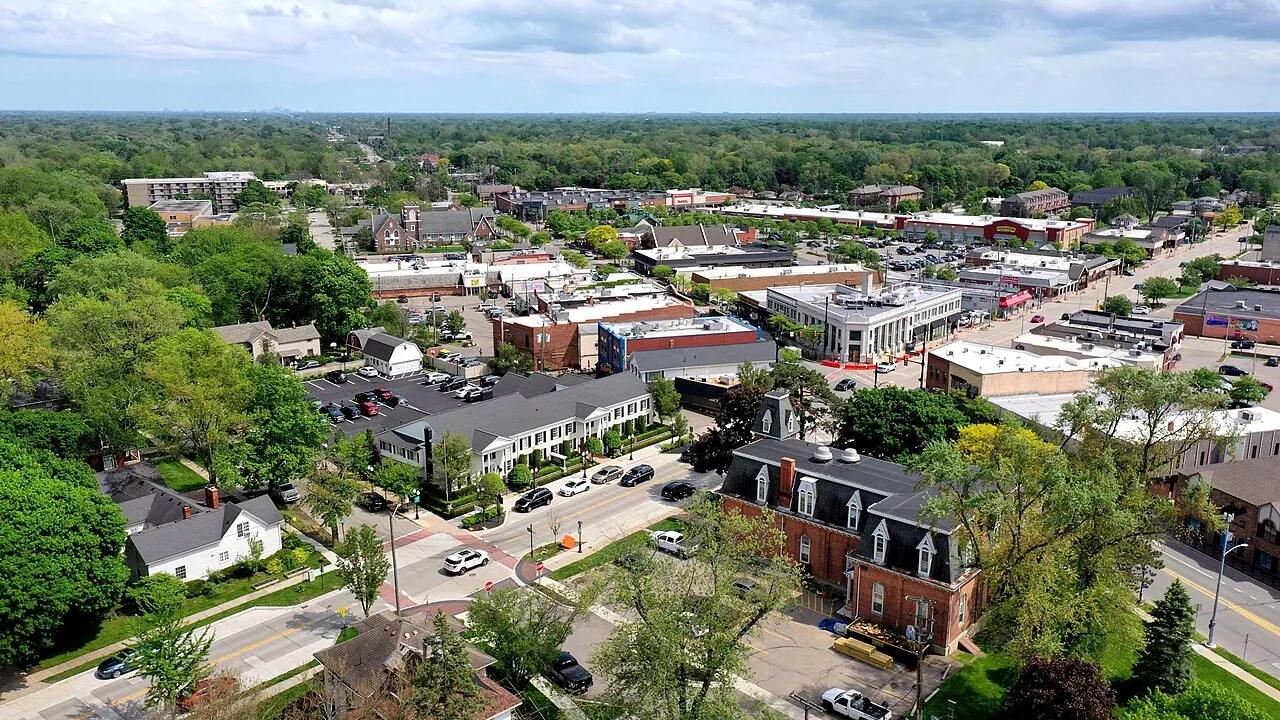
Commercial Roofing in Farmington Hills, MI
A business corridor that is being refreshed outside can still be failing on top. Along Grand River in Farmington Hills, MI, the city's Corridor Improvement Authority works on appearance, connectivity and economic competitiveness, and a grant program there supports site upgrades such as facade work, exterior lighting and parking-lot resurfacing. The program excludes routine or deferred maintenance. An owner who counts on it for visible improvements should plan separately for the membrane, flashing and drains that keep the interior dry.
We inspect, repair, recover and replace commercial roofs across the city, from a single-tenant office to a multi-building business property. Written findings come first, with photographs, a ranking of what needs action and what can wait, and the cost drivers behind each choice.
Business Properties of Different Sizes
Farmington Hills reports about 3,500 businesses, ranging from start-ups to international corporations. A range that wide means the roofs vary in age, size and equipment load. A start-up in a leased suite may have no say over the roof and need a clear letter to the landlord. A corporate occupant may hold a building with dozens of rooftop units and a long maintenance history.
On a first visit we identify the roof type, the number and position of penetrations, the drainage layout and the condition of the field, then match the repair or replacement options to that building's use. The office building roof is usually a quiet, low-slope assembly, and our scheduling reflects the people working under it.
Roof age is the question underneath every other one. A membrane past its service life can look fine from the ground and still be thin at the seams, brittle at the corners and soaked beneath. We core or probe in representative spots, record thickness and moisture, and estimate remaining service life in plain terms, so an owner can plan replacement for a quarter that suits the budget, not the week the ceiling fails.
Facade, Lighting and Parking-Lot Projects Above and Below the Roof
Facade work and exterior lighting meet the roof at the parapet, the coping and the wall flashing. When a building is being refreshed, a scaffold or lift is often on site already, which makes the roof edge cheap to inspect and repair in the same visit. We check coping joints, sealant, through-wall scuppers and the base flashing, and we record failures before a new finish covers the evidence.
Parking-lot resurfacing brings heavy trucks and sometimes dust and debris onto roofs through open vents and intakes. We cover intakes, protect membranes near hoist points, and look for punctures after the contractor leaves. A membrane puncture repair is quick when the hole is found the same week. Left open, it feeds water into insulation until a ceiling stains.
Deferred Items That Grow
Because the corridor grant excludes routine and deferred maintenance, the roof items that tend to be deferred are worth naming. A clogged drain bowl, a split sealant bead, an unsecured edge metal, a lifted seam at a corner and a cracked boot around a vent pipe are small repairs today. Each one lets in water that wets insulation, and wet insulation turns a repair into a replacement.
Our written findings put these items in order and price them. When an owner wants to budget, an infrared moisture survey shows where insulation is already wet, so the large-ticket question, repair or replace, can be answered with data. A roof condition report gathers the findings in a form a lender, a landlord or a board can read.
Photographs are tied to a roof plan, so each finding can be located again by a facility manager who was not on the roof with us.
Freeze-Thaw and Drainage on Flat Roofs
Dearborn, the nearest long-term weather reference, averages 30.8 inches of snow a year, mostly November to April, within 35.05 inches of total precipitation, and the Detroit forecast office puts the first measurable snow around mid-November and the last in the opening days of April. A flat roof in Farmington Hills works through the same long freeze-thaw season. Snow and ice sit against parapets, melt toward a few outlets and refreeze overnight.
The detail that controls most winter leaks is the drain. We photograph each bowl and strainer before winter and again after the first thaw, and we look for ponding around outlets, which signals a roof that slopes toward a drain that is not receiving water. A ponding water repair can be as small as new tapered insulation at one outlet.
Planning Work Around Occupants
Offices, clinics, showrooms and service businesses do not all want the same hours. We agree on an access window with the facility manager, identify entrances, parking and noise limits, and set the lift or hoist where it will not block customer or delivery traffic. At day's end every open section is dried in, so a late-afternoon storm does not turn into an interior claim.
For owners who keep property in Novi, Southfield or Livonia as well, one inspection format for every building makes the comparison easy. A multi-site program turns the findings into a shared budget calendar instead of a series of separate emergencies.
Rooftop equipment needs its own plan. Where a unit has to be disconnected, lifted or shifted, we coordinate with the building's mechanical contractor so cooling and ventilation are down for the shortest time and never during the hours when the space is full.
Commercial Roofing Questions
Can corridor improvement dollars be used for a roof?
The Farmington Hills program supports facade work, exterior lighting and parking-lot resurfacing, and it excludes routine or deferred maintenance. Whether a particular roof item qualifies is a question for the authority. We can supply photographs, a scope and a price range for any roof work that touches the facade so that the owner has paper to bring to that conversation.
Should the parapet be checked before the facade is refinished?
Yes, in most cases. A lift or scaffold is already in place, the coping and wall flashing are exposed, and any repair can be finished before the new surface covers the evidence. We record sealant, joints and brackets in writing and fix what is failing under the same access.
My lease makes the landlord responsible for the roof. What can a tenant do about a leak?
Document it. Photographs of the stain, the date and the weather help, and a written inspection from us can be sent to the landlord or property manager. We can describe the source, the likely repair and the urgency, and we can coordinate with the landlord's chosen contractor if they prefer.
How do you decide whether a leak calls for a patch or a larger repair?
We map the wet area first with an infrared scan or moisture probe. If the insulation is dry and the sheet is sound, a localized repair holds. If the insulation is wet across a broad area, patching hides the next failure, and a section replacement or recover is a better choice.
What does Michigan's current code mean for a replacement in Farmington Hills?
The state's current commercial building code is the 2021 edition, effective April 9, 2025, and the matching energy code is also the 2021 edition, effective April 22, 2025. A tear-off can trigger insulation requirements depending on scope. We write our assumptions into the proposal, and the owner confirms them with the local authority before a price is final.
Schedule a Farmington Hills roof inspection
Tell us the building, what the tenants do and where water has appeared. We will document the membrane, edges, drains and penetrations in writing with photographs, and the record will support your choice among repair, recover and replacement. Emergency response is available at any hour.
