
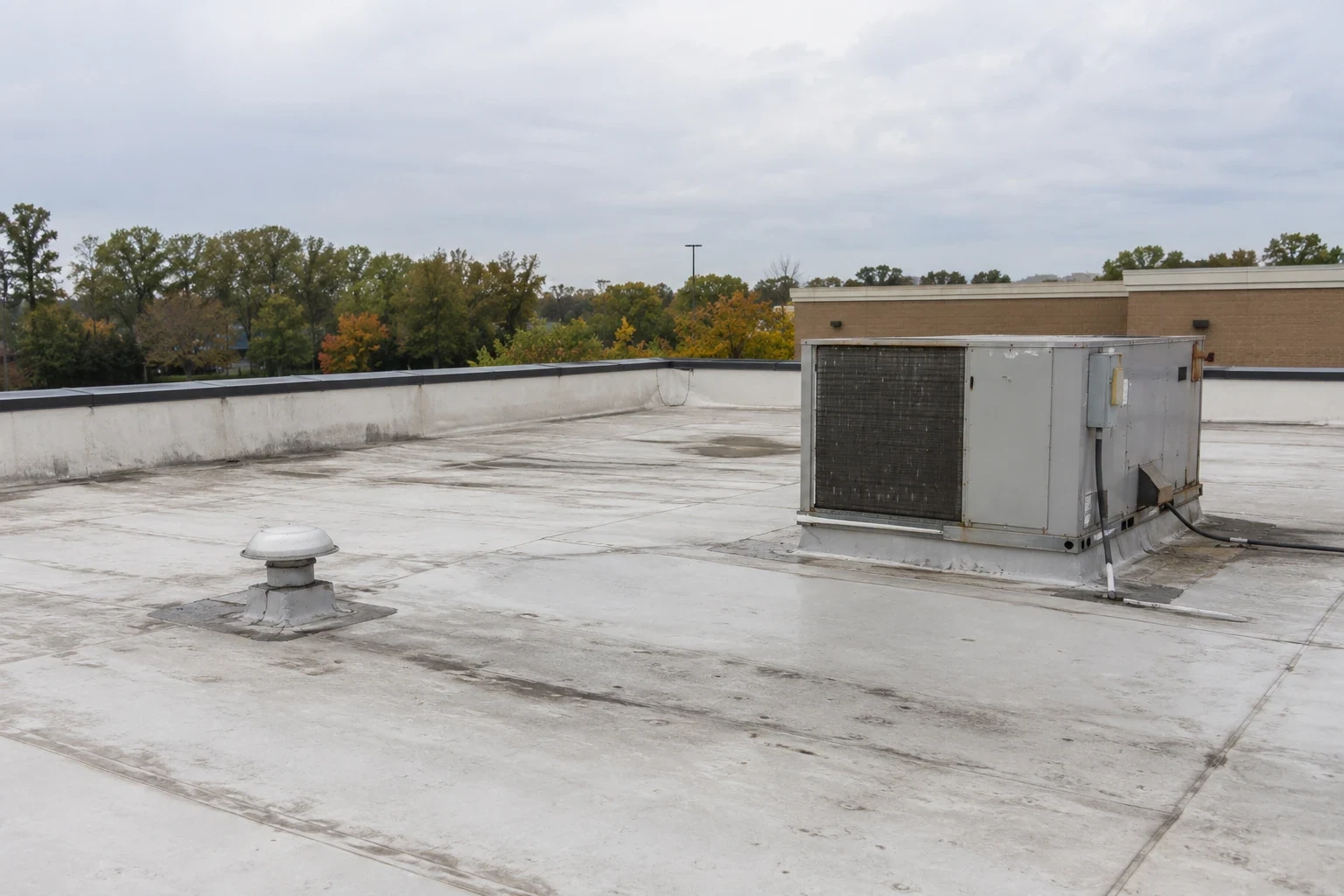
Grocery Store Roofing in Dearborn, MI
Refrigeration changes what a grocery roof carries and what a leak costs. Condensers, rack equipment, exhaust from the bakery and make-up air for the deli all sit on the roof, and below them are open cases, stocked shelves and a floor that customers walk across all day. In Dearborn, MI, where the city lists grocery stores along Warren Avenue and in West Downtown, the roof over each store protects perishable stock as well as the building.
The first question on a grocery inspection is therefore what lies under each roof section. The back-of-house cooler, the produce wall and the bakery each tolerate water differently, and the findings rank sections by the value of what water would reach.
Condensers, Rack Equipment and Line Sets
Refrigeration equipment is heavy and vibrates, and its line sets cross the roof in long runs. Each condenser sits on a curb or a stand, and each line passes through the membrane at a penetration. Vibration loosens fasteners, line supports rub the surface and sealants at penetrations dry. We inventory every unit and every line crossing, check the curbs and supports for level and fastening and photograph each penetration with a reference mark.
The rooftop equipment curbs and supports record shows which stands sit directly on the membrane without a pad. A stand with no protection wears through the surface in time, and a pad is a small cost against a membrane repair. Line supports get cushioned bearings so they do not saw into the roof as the lines expand and contract.
Condenser replacement is a roofing event too. When a unit is swapped, the old curb is inspected, the flashing is reset or rebuilt and the line penetrations are resealed or moved. We ask the refrigeration contractor for the swap date and the crane or lift position, because a crane set on a membrane without protection can crush insulation under its outriggers. Pads or plywood spread the load, and the position is marked on the plan before the lift.
Condensate, Grease and Water Staining
Cooling equipment makes water, and the water has to go somewhere. A condensate line that discharges onto the membrane wets one patch every day, which grows algae, softens sealants and wears the surface. We trace each line to its end and recommend piping it to a drain or a splash pad. Bakery and deli exhaust adds grease, which settles around the fan and softens some membranes.
We record where staining starts and stops around each discharge and compare it with the membrane type. A PVC membrane resists grease better than many alternatives, and the choice is explained in the findings. If grease has soaked into the insulation near a curb, that board is cut out and replaced, since a greasy board holds water and does not dry.
Drain lines from air handlers and cases can also freeze in the cool season. A line that runs across the roof surface and ices over backs water onto the membrane, and a heat-traced line needs its own power and protection. We check each run for slope, support and insulation, and we list any line that crosses the roof without a support. The fix is usually a short rerouting or a pad, and the cost is small compared with a leak into the sales floor.
Protecting Food and Customers During Repairs
Water over stock is a food-safety issue, not just a repair issue. The first response protects what is below: covers over shelves, a catch under any active drip, cases moved if necessary and a clear path for staff. The store manager decides what moves and when, and the plan records it. If a leak reaches product, the store handles it under its own rules, and our record notes the time and place so the manager has what is needed.
Dust and odor need control. Tear-off dust can enter through rooftop intakes, and adhesive vapors can reach the sales floor. The plan marks the intakes, covers or shuts them for the loud and odorous steps with the manager's approval and chooses welded or mechanically attached methods where the roof allows.
Receiving is the other operation to protect. Trucks arrive early, and coolers must stay closed for loading. The lift, dumpster and material staging are placed away from dock approaches, and the plan shows the hours when the crew is not on the dock side. The store's receiving schedule goes into the work plan, and the supervisor reviews it before any roof section is opened.
Grocery Roofs on Warren Avenue and Downtown Streets
Warren Avenue in Dearborn runs between Greenfield Road and Wyoming Avenue, and the city lists grocery stores, bakeries, cafes and pharmacies among its businesses. West Downtown Dearborn, on Michigan Avenue, includes groceries among its storefront mix. A store on Warren Avenue may share walls and drainage with neighbors, and a store in West Downtown may sit in a historic streetscape where roof changes are visible from the sidewalk.
Neighboring roofs follow the same method, with their own details: a restaurant roof adds kitchen exhaust, and a shopping center roof adds party walls. We inventory what is actually on each roof and do not assume the pattern.
Snow, Thaw and Drain Bowls
A grocery roof sees snow from early winter to spring: 30.8 inches in a typical Dearborn year, with first flakes near mid-November and the last near the first week of April. On a grocery roof, snow settles around condensers and parapets and thaws toward drain bowls. A blocked bowl ponds water over equipment curbs and puts flashing under water for hours.
Drains are cleared before the first snow and checked after the first thaw. Heavy snow near rooftop equipment can also block airflow to condensers, so the access plan includes who clears snow from units and how they reach them safely.
Repair, Recover and Replacement
The moisture survey and cores decide the path. Dry insulation and sound seams support repair or recover. Wet insulation across a section calls for replacing that section, and since the state energy code adopted on April 22, 2025 can add insulation depending on scope, the building department is consulted first. Phased work keeps the store open, with one section opened and dried in each day, and the written findings track the sequence.
The cost update separates the roof from the store. It lists the temporary work, the permanent repair and any interior protection, and it shows the remaining service life of each roof section so the owner can budget replacement before an emergency forces it. A grocery operator with several stores can ask for the sections to be ranked together, because the same method and the same photographs work in each.
Commercial Roofing Questions
What is checked first on a grocery roof?
The refrigeration equipment and its line crossings. Condensers, stands and penetrations are the most common leak and wear points, and the inventory lists each with a photograph before we look at the open field.
Why does condensate matter to the membrane?
A line that discharges onto the roof wets the same patch daily. Algae, softened sealants and surface wear follow. Piping it to a drain or a splash pad costs far less than a membrane patch.
Can the store stay open during a reroof?
Yes, with zoning. Work is staged by section, each opened area is dried in daily, intakes are covered or shut at the manager's direction and the loudest steps move to quiet hours.
Which membrane suits bakery or deli exhaust?
PVC resists grease better than many single-ply options. The observed condition around each fan guides the choice, and the findings record why one membrane was recommended over another.
What record helps with an insurance claim after a leak?
The time of the report, photographs of the stain and the roof above it, the temporary protection and the cost. We keep that sequence in the file and update it at each step.
Schedule a grocery roof inspection
Tell us where the refrigeration equipment sits, which areas hold the most valuable stock and when deliveries arrive. We will inspect the roof, document the findings with photographs and a written record and give you repair and replacement paths to price.